
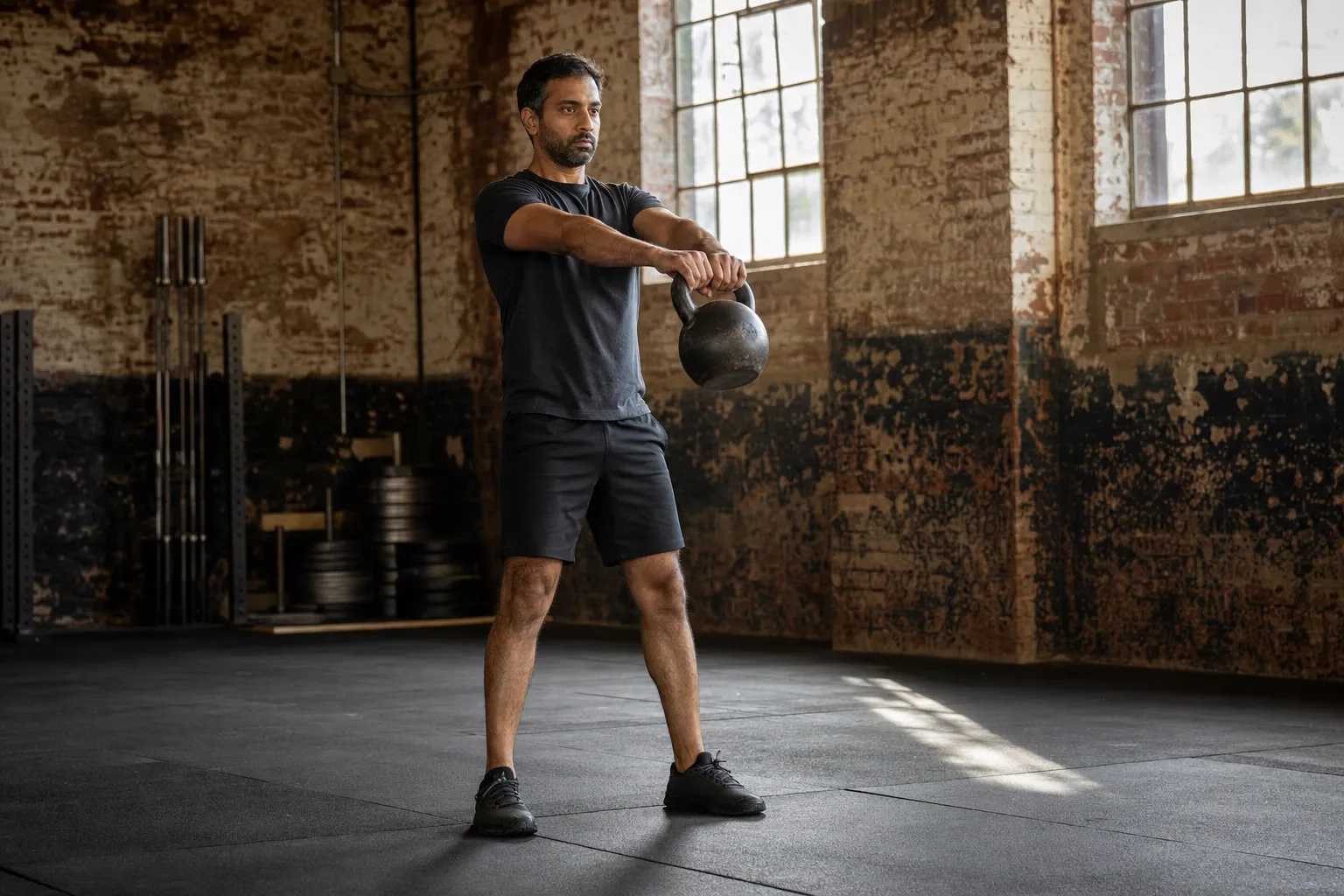
A kettlebell swing is a hip hinge performed with momentum. Your hips accelerate the bell. Your arms guide its arc. The bell floats in front of you, then returns between your legs as you hinge again.
The basic two-hand swing has six parts:
- Place the bell on the floor slightly in front of you.
- Hinge and grip the handle with both hands.
- Pull the bell back high between your legs.
- Drive your feet into the floor and extend your hips.
- Let the bell float to roughly chest height.
- Wait for it to fall, then hinge and receive the next backswing.
That sounds short because the movement is short. The difficulty is timing the hinge to the bell rather than turning the swing into a squat or an arm raise.
Start with the hinge
Before you swing a kettlebell, make sure you can hinge without one.
Stand with your feet between hip and shoulder width. Soften your knees, send your hips backward, and let your torso incline while your feet remain planted. Your shins should stay closer to vertical than they would in a deep squat. Stand by pressing the floor away and bringing your hips back under your ribs.
The hinge does not need to look identical on every body. Limb length, stance, and kettlebell size change the exact angles. The useful distinction is where the movement comes from:
- In a hinge, the hips travel backward and the torso inclines.
- In a squat, the knees and hips bend together while the torso stays more upright.
The swing uses some knee bend, but the hinge supplies its main shape. If you cannot keep that pattern without load, practice bodyweight hinges and kettlebell deadlifts before adding speed. The kettlebell warm-up guide includes a short progression you can use before a swing session.
Set the bell in front of you
Place the kettlebell roughly a foot in front of your toes, with the handle running across your body. Use a stance that gives the bell room to pass between your upper thighs without forcing your feet excessively wide.
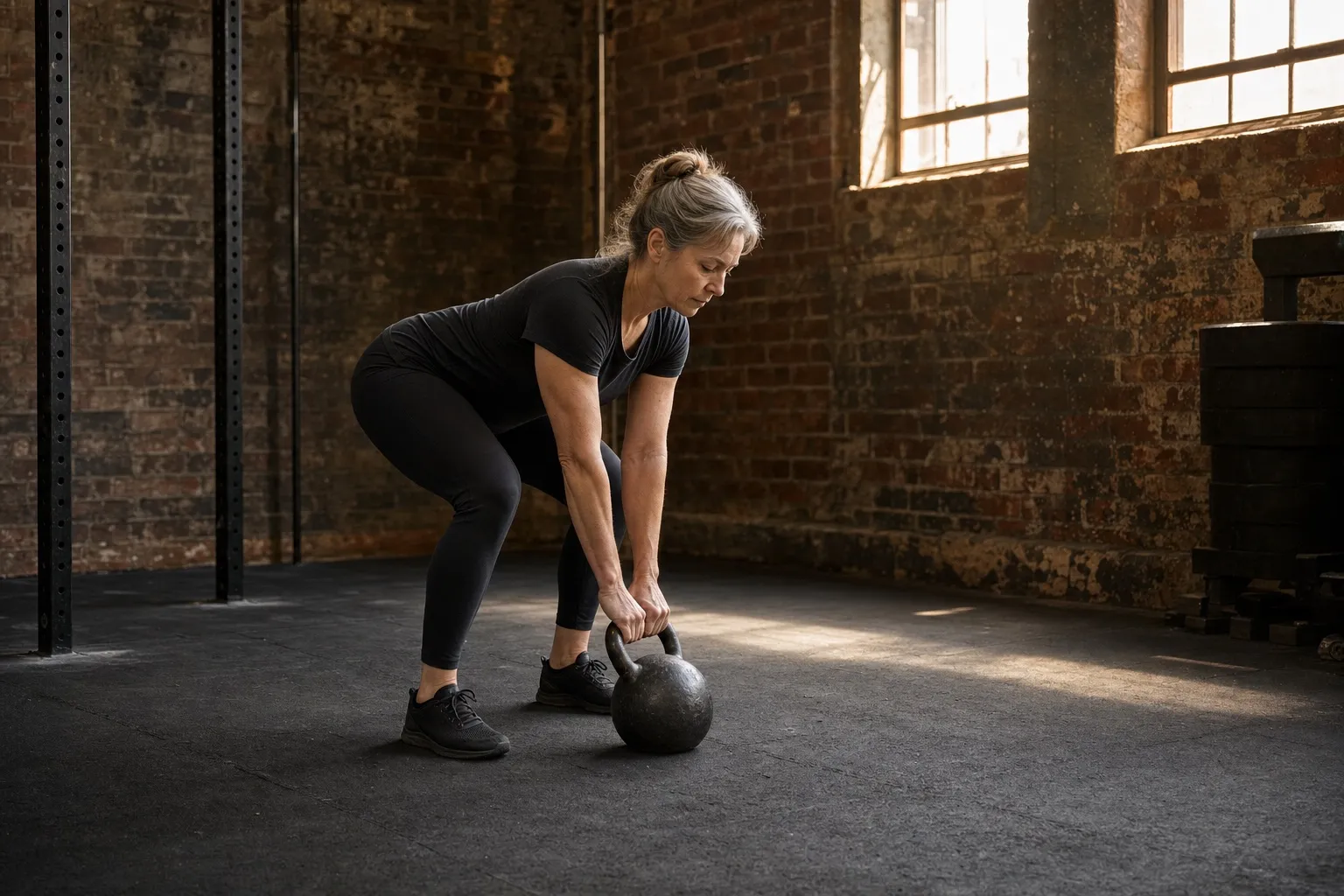
Hinge back until you can reach the handle. Grip it with both hands and wrap your fingers fully around it. Tilt the bell toward you so its handle angles back and its bottom edge stays on the floor.
Your shoulders should remain above your hips, your back should hold its ordinary neutral shape, and your neck should follow your torso rather than craning to look ahead. You should feel ready to pull the bell backward, not lift it straight up.
Hike the bell back
Pull the handle back between your legs as if passing the bell behind you. Keep it close. A loose, low arc makes the bell feel heavier and gives it more leverage against your torso.
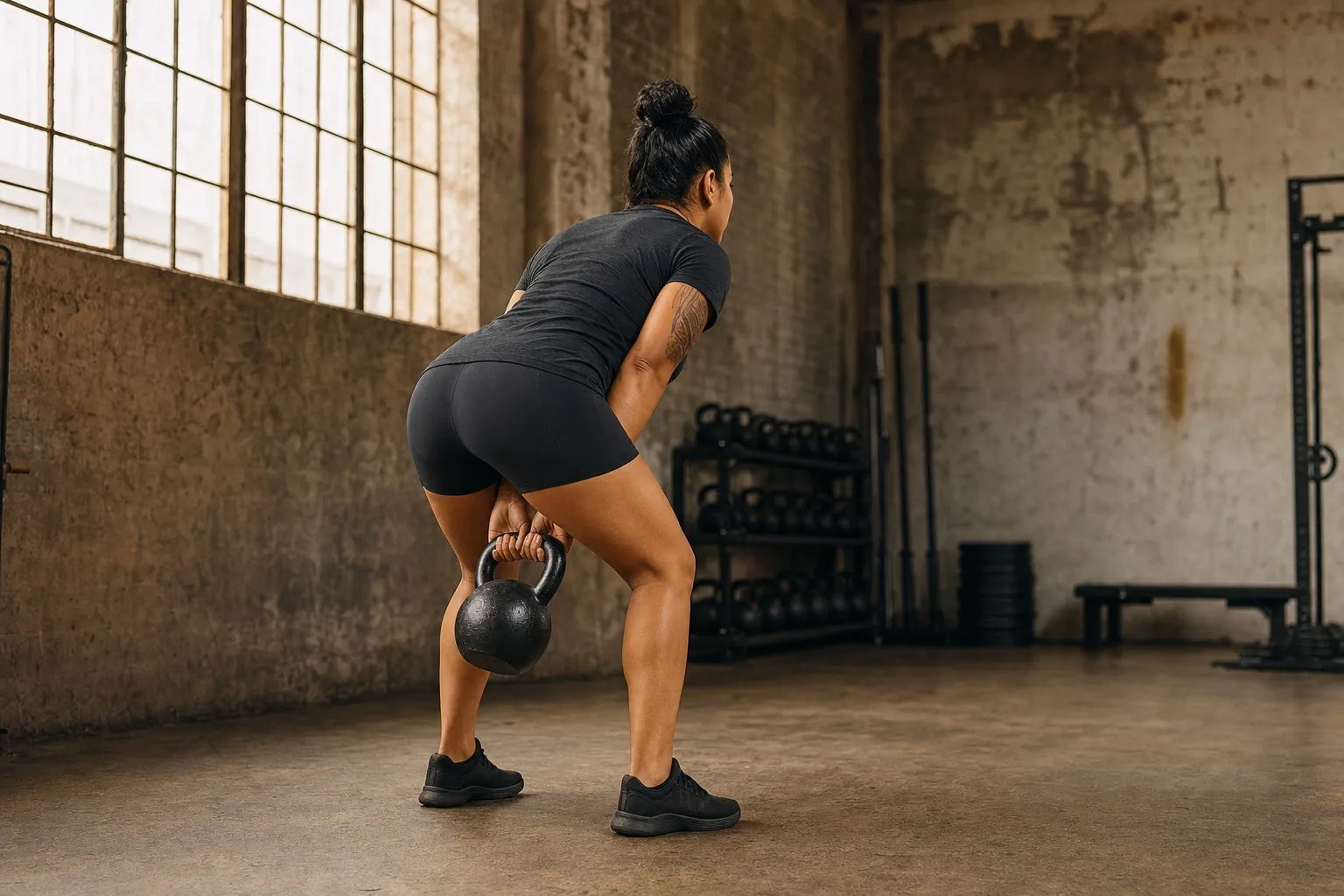
At the deepest point, your forearms should be near your upper thighs and the bell should travel behind the line of your heels. Your knees remain softly bent while your hips stay back. Do not pause there; the backswing stores the position you will reverse into the next drive.
The first hike establishes the path for every repetition that follows. If it starts as an upward lift from the floor, the rest of the set usually becomes an arm exercise.
Drive, then let the bell float
As the bell reaches the end of the backswing, press your feet into the floor and extend your hips and knees. Finish standing tall with your ribs stacked over your hips.
The bell will travel forward because the lower body changed its direction. Keep your elbows straight but not rigid. Your hands are hooks on the handle; they do not need to pull the bell upward.
Let the bell rise only as high as the drive sends it. For a basic swing, that is usually somewhere between lower chest and eye level. The exact height changes with the bell, the force of the repetition, and your proportions. Height is not the score.
At the top:
- stand tall rather than leaning backward;
- keep your feet planted;
- let the bell become briefly weightless; and
- keep your shoulders connected without shrugging toward your ears.
If the bell stops below chest height but the repetition is crisp, it is still a swing. If you have to bend your elbows or lift your shoulders to reach a target, stop chasing the target.
Wait, then hinge
The return is where many swings lose their rhythm. Do not send your hips backward the instant the bell starts to fall. Stay tall while it descends. Begin the hinge when your upper arms approach your ribs and the bell is close enough to pass between your legs.
Think of the bell and hips trading places: the bell comes back as the hips go back. This keeps the weight close and makes room for the next backswing.
Receive the bell high between your thighs, not down near your knees. Your torso inclines, your knees soften, and your feet remain firmly on the floor. At the end of the backswing, reverse the motion immediately into the next drive.
Finish the set on purpose
Do not simply stop driving and hope the bell finds the floor.
After the final float, let the bell return for one last controlled backswing. As it comes forward again, keep your arms long and guide it to the place where it started. Hinge with the bell, set its base down, then release the handle.
The finish should look like a reversal of the first hike. Leave enough clear floor in front of you that the bell can return without hitting another object. Keep people and pets outside the entire arc before the set begins.
Five common swing mistakes
1. Squatting every repetition
If your knees travel forward and the bell drops toward the floor, return to unloaded hinges and deadlifts. Think about reaching your hips toward the wall behind you rather than lowering them between your heels.
2. Lifting the bell with your arms
If your shoulders tire first or your elbows bend to create height, let the next few swings rise lower. Keep your arms long and see whether a clean hip drive makes the bell float on its own.
3. Hinging too early
If the bell pulls you forward or bumps low on your thighs, you may be moving your hips back before the bell reaches you. Stay tall for a fraction longer. Hinge when your upper arms reconnect with your torso.
4. Leaning back at the top
The top is a tall standing position, not a backbend. Finish with hips under ribs and your head over your pelvis. If the bell’s momentum keeps pulling you behind that line, reduce the load or the force of the repetition.
5. Chasing more repetitions after timing changes
A set is done when the hinge becomes a squat, the bell path drops, the grip starts slipping, or the finish becomes uncertain. The planned number can wait. Repeating altered repetitions only practices the alteration.
A first practice session
Use a bell you can deadlift and control comfortably. If you are still choosing one, start with the beginner kettlebell sizing guide and test neighboring weights when possible.
Then try:
- 2 sets of 8 unloaded hinges;
- 2 sets of 5 kettlebell deadlifts;
- 5 single swings, parking the bell after each repetition; and
- 5 sets of 5 continuous swings, resting 45–90 seconds between sets.
Five repetitions are long enough to find a rhythm and short enough to notice when it changes. Rest more if you need it. Stop the session if you cannot keep the bell path, hinge, and controlled finish consistent.
If the movement still feels unclear, work with a qualified coach who can see the bell from the side. A short correction in person is often more useful than adding repetitions to a pattern you cannot yet evaluate.
Once the two-hand version is repeatable, the guide to one-arm and two-arm swings explains what changes when one hand leaves the handle and when each variation is useful.
Track the work you can repeat
Use a set-by-set workout log to record the bell, repetitions, sets, and rest. Those four details let you return to the same session without guessing. Technique notes can stay short: “hinged early on set four” is more useful than a general rating of good or bad.
Pood is built for that kind of mid-workout record. Log each swing set with one hand, let the rest timer run, and keep the history needed to compare the same bell and rep scheme later.
The swing is not an arm raise with a kettlebell. It is a hinge, a drive, a float, and a return. Learn that sequence before you add speed, load, or volume.