
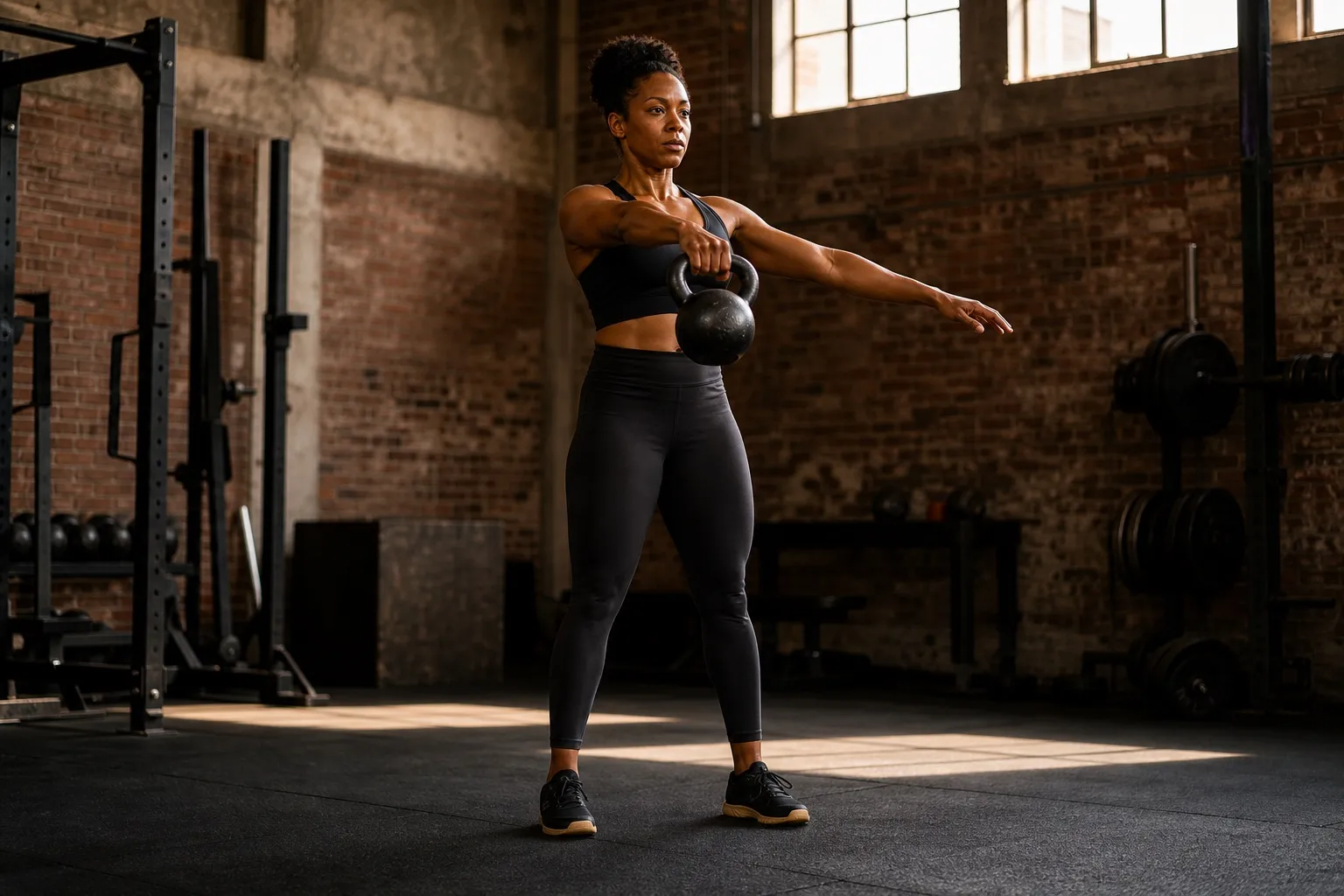
One-arm and two-arm kettlebell swings use the same engine: a hinge, a forceful hip drive, a brief float, and a return timed to the bell. Changing the grip does not replace that sequence. It changes how you control it.
The two-arm swing gives the bell a centered path and spreads the handle across both hands. The one-arm swing puts the entire handle, grip demand, and off-center pull on one side at a time. Neither is the universal “better” swing. Each solves a different training problem.
If you are still learning the basic movement, begin with the step-by-step two-hand swing guide. Build a repeatable hinge and a controlled finish before removing a hand.
What stays the same
Both variations should look like swings rather than front raises or repeated squats. In either version:
- the hips travel backward during the hinge;
- the legs and hips reverse the bell out of the backswing;
- the elbow stays long without being forced rigid;
- the bell floats because of the drive, not because the arm lifts it; and
- the next hinge waits until the falling bell approaches the body.
The useful comparison starts after those basics are in place. A one-arm swing is not a new lower-body movement. It is the same hinge performed with less help at the handle and a less symmetrical load above it.
What changes when one hand comes off
With two hands, the kettlebell sits close to your centerline. Both shoulders connect to the handle, and both hands share the work of keeping it there. That makes the path easier to judge and the grip less likely to end a set before the hinge does.
With one hand, the bell pulls from one side. Your trunk has to manage that offset without letting your feet pivot or your torso follow the bell into a large twist. Your free arm can move naturally for balance, but your ribs and pelvis should remain mostly directed forward.
One hand also changes the relationship between the bell and the handle. Center your working hand rather than gripping one corner. A centered grip gives the bell room to hang below the hand instead of pulling it toward one leg.
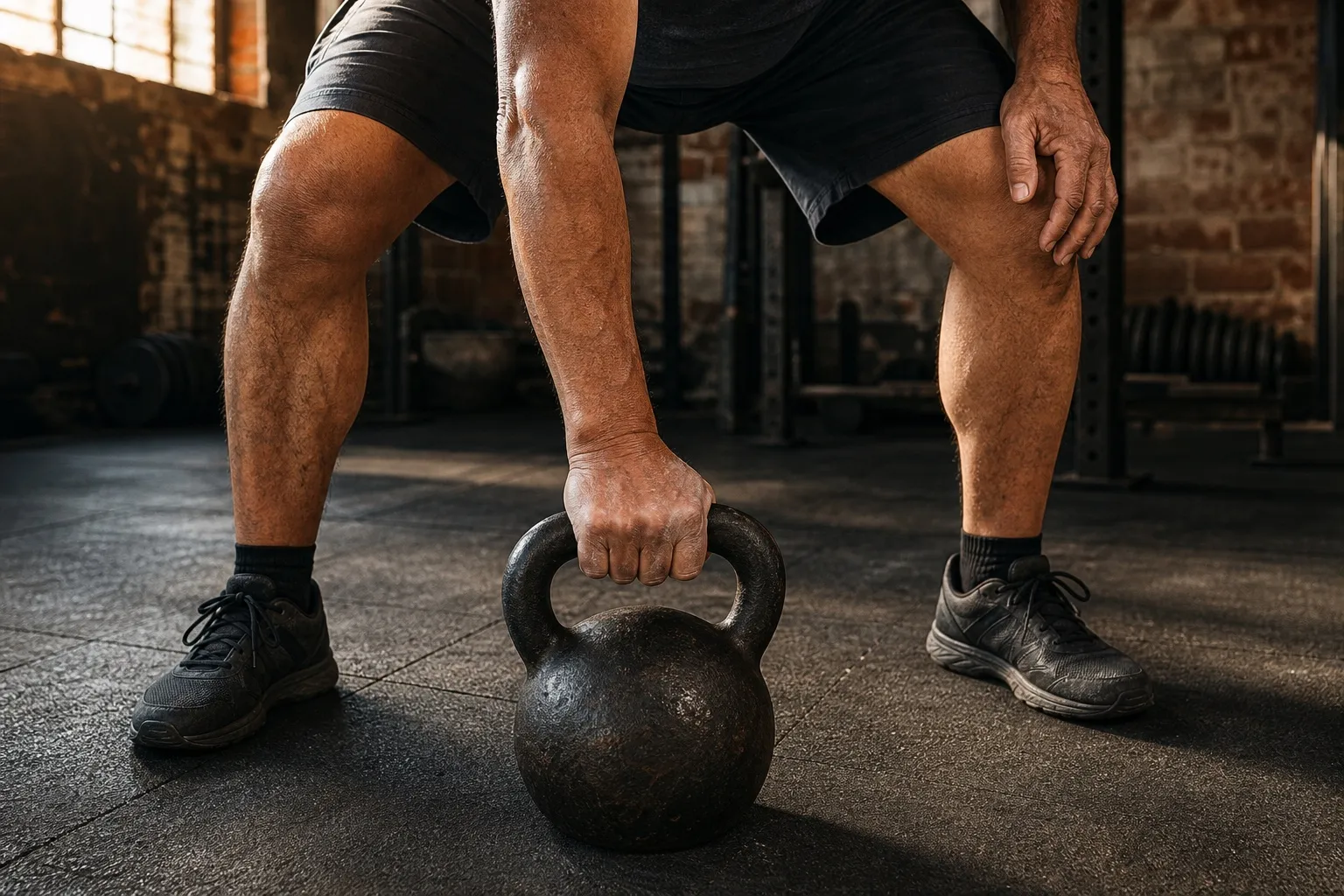
Do not try to freeze the working shoulder in place. A small amount of natural movement is expected as the bell travels. The goal is control: the bell stays close, the feet stay planted, and the hinge remains recognizable from one repetition to the next.
Use two arms to learn and repeat the swing
The two-arm swing is usually the clearer choice when you want to:
- learn the timing of the hinge and float;
- practice more repetitions without grip being the first limit;
- use a bell that is too demanding for one-hand control;
- keep the bell path easy to observe; or
- train a simple swing session without managing sides.
Because both hands share the handle, you can often use a heavier bell in the two-arm version. That does not automatically make it the harder or more productive exercise. It simply means the available load and the limiting factor are different.
Two-arm sets also make counting straightforward. Ten repetitions are ten total repetitions. This is useful when you want consistent work and rest intervals, especially before your technique is automatic.
Use one arm to add side-specific demands
Choose the one-arm swing when your two-arm reps are already stable and you want to:
- train each hand’s grip separately;
- practice controlling an offset bell path;
- prepare for other one-arm kettlebell movements;
- expose a side that loses timing sooner; or
- divide the session into explicit left and right work.
The one-arm version can reveal differences that two hands hide. Perhaps one side over-grips, hinges early, or lets the bell drift outward. That is information, not a reason to force the weaker pattern through a longer set. Shorten the set and keep the same technical standard on both sides.
If the clean is your next one-arm movement, use the smooth kettlebell clean guide to turn that same backswing into a close path and quiet rack position.
Small laboratory comparisons support the idea that the variations distribute work differently, but they do not establish a universal winner. In one study of 16 men using a 16 kg bell, one-arm and two-arm swings produced different side-to-side patterns of trunk muscle activity. A separate descriptive study of 23 young adults found substantial hip-muscle recruitment in both variations. Those studies are useful context, not a prescription for your exact bell, body, or program.
A practical comparison
| If the priority is… | Start with… | Why |
|---|---|---|
| Learning swing timing | Two arms | A centered bell and shared grip reduce variables. |
| Using a heavier bell | Two arms | Both hands control the handle. |
| Training grip by side | One arm | Each hand performs its own full set. |
| Practicing offset control | One arm | The bell pulls from one side. |
| Simple higher-repetition sets | Two arms | No hand changes or side accounting are required. |
| Preparing for one-arm movements | One arm | The grip and side-specific control transfer directly. |
This is a starting point, not a rule that locks one variation to one outcome. Your available bells matter. If your next heavier bell makes the two-arm swing crisp but the one-arm swing erratic, use the lighter bell for one-arm work. If the lighter bell is too easy with two hands, the same bell may still be useful for clean one-arm practice.
How to move from two arms to one
Make the transition with parked repetitions rather than a long continuous set.
- Perform 5 controlled two-arm swings and park the bell.
- Rest until your breathing and grip are ready.
- Perform 3 one-arm swings on the left, then park the bell.
- Repeat 3 on the right.
- Complete 3–5 rounds, resting 45–90 seconds between rounds.
Parking the bell lets you reset the grip and stance before every side. Start each one-arm set with the working hand centered on the handle. Keep the free arm out of the bell’s path; it can travel beside you rather than reaching across the body.
When sets of three stay consistent, move to five per side. Add repetitions only while the grip remains secure, the bell stays close, and both sides keep the same rhythm. You do not need to change hands while the bell is airborne. A deliberate park and restart is a complete way to train the movement.
Common comparison mistakes
Assuming one arm is automatically advanced
Complexity is not the same as usefulness. If two-arm swings better match the bell, space, and purpose of the session, use them. Progress does not require replacing every simple movement with a less symmetrical version.
Using the same weight without testing it
A bell you can swing comfortably with two hands may exceed your one-hand grip or path control. Test a lighter option when possible. The beginner kettlebell sizing guide explains why movement and control matter more than a universal starting number.
Letting the one-arm swing become a rotation drill
Some shoulder movement is natural, but a large torso turn changes the exercise. Reduce the load or shorten the set if the bell pulls one shoulder far ahead of the other or makes a foot pivot.
Logging one-arm repetitions ambiguously
“Ten swings” can mean ten total or ten per side. Write it as 5 left + 5 right, 10 per side, or another unambiguous split. A consistent set-by-set record prevents an accidental doubling of volume when you repeat the session.
Track the variation, side, and bell
For two-arm swings, record sets, total repetitions, bell, and rest. For one-arm swings, add the side. If the sides used different repetitions or bells, record them separately rather than averaging them into one set.
Pood is designed for that mid-session distinction. Choose the one-arm swing, log left and right work separately with one-handed controls, and keep the bell and rest interval attached to the set. When you return to the workout, you can repeat the same version instead of guessing what “swings” meant last time.
Use two arms when you want the cleanest route to rhythm, load, and repeatable volume. Use one arm when you want grip and offset control to become part of the task. Keep both in your toolbox, and choose the one that makes the session more specific—not merely more complicated.