
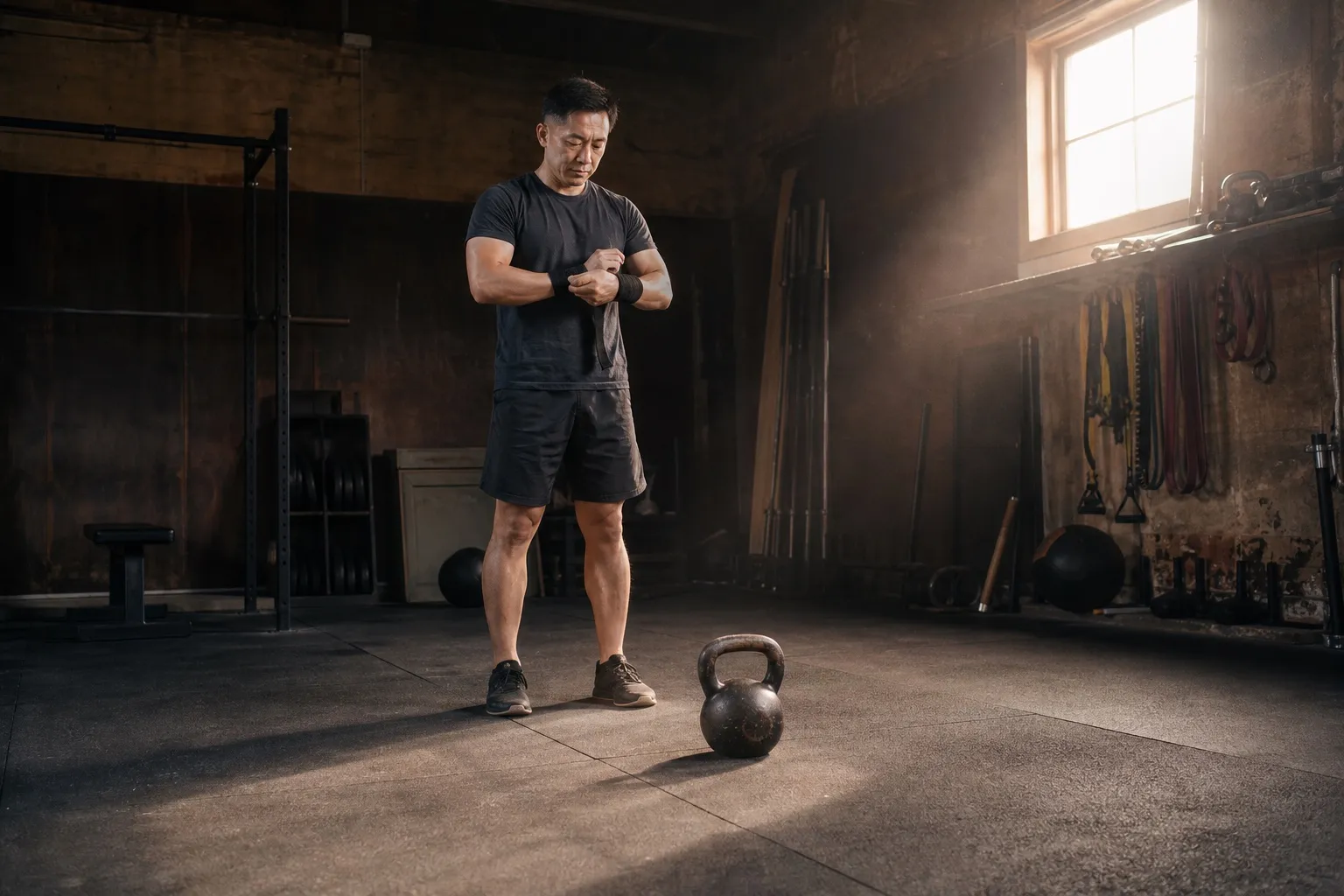
A minimalist kettlebell program gives a small number of movements enough time to become familiar, measurable, and useful. It does not mean doing the least work possible. It means removing choices that do not help you train.
For many home lifters, a complete plan can fit on one page:
- two to four training days each week;
- three to five dependable movements;
- a clear number of sets and repetitions;
- a rule for adding work or weight; and
- enough repetition across weeks to compare one session with the next.
The result is easier to start and easier to evaluate. You know what you planned, what you completed, and what should change next time.
Minimal equipment rewards repeated practice
A kettlebell is unusually good at covering several training jobs with little equipment. One bell can support a hinge, squat, press, row, carry, and get-up. The constraint is load: the right weight for a two-hand swing may be too heavy for a one-arm press, while a comfortable press bell may be light for deadlifts.
Minimalist programming accepts that constraint. Instead of forcing the same load into every movement, you choose movements that fit the bells you own. A heavy bell might handle swings, squats, and carries. A lighter bell might handle presses and get-ups. Bodyweight work can cover pushing or pulling when neither bell fits.
If you are building around a single weight, the one-kettlebell home gym guide explains how to match movement choices to the bell rather than inventing complexity to compensate for it.
Cover a few jobs, not every exercise
Start with movement categories. You do not need one exercise from every category in every workout, but your week should reflect the work you care about.
| Training job | Practical choices | What to record |
|---|---|---|
| Hinge | Deadlift, two-hand swing, one-arm swing | Sets, reps, bell, side when relevant |
| Squat | Goblet squat, reverse lunge | Sets, reps, bell |
| Push | Press, floor press, push-up | Sets, reps, bell or bodyweight |
| Pull | One-arm row, pull-up | Sets, reps, bell or bodyweight |
| Carry | Suitcase, front-rack, or overhead carry | Time or distance, bell, side |
| Ground transition | Get-up or a practiced segment | Reps, bell, side |
Choose three to five movements you can perform consistently. More exercises create more variety, but they also create more records that are hard to compare. Repeating a press for six weeks tells you more about that press than changing the variation every session.

Give each session one clear emphasis
A short session becomes muddled when every movement competes to be the main event. Give one job priority, then use the remaining work to support it.
A hinge-focused session might be:
- Two-hand swings: 8 sets of 10.
- Goblet squats: 3 sets of 5.
- One-arm rows: 3 sets of 8 per side.
A press-focused session might be:
- One-arm presses: 5 sets of 3 per side.
- Reverse lunges: 3 sets of 5 per side.
- Suitcase carries: 3 rounds of 30 seconds per side.
Those are examples, not universal prescriptions. Adjust the bell, repetitions, and movements to your current ability. The important structure is priority work first, a small amount of complementary work afterward, then a stop.
Before the first work set, use a short warm-up that resembles the session. The kettlebell warm-up guide shows how to move from unloaded rehearsal to a small version of the work you plan to log.
Repeat the week before you revise it
Run the same weekly structure long enough to produce useful evidence. Four to six weeks is a practical first block for a plan built from familiar movements. That is long enough to repeat each session several times without pretending the calendar guarantees a result.
For three weekly sessions, you could organize the work like this:
| Day | Priority | Supporting work |
|---|---|---|
| Day 1 | Hinge | Squat and pull |
| Day 2 | Press | Lunge and carry |
| Day 3 | Hinge or get-up | Push and pull |
The days do not need fixed weekday names. Train, recover, then perform the next session in order. If life moves Tuesday’s work to Wednesday, the program has not failed.
Two days per week can also work: alternate a hinge-and-squat day with a press-and-pull day. Four days can use shorter sessions, with hinge and press work separated. Frequency is useful only when it fits the amount of work you can repeat.
Change one variable at a time
A program needs a progression rule before it needs more exercises. Pick the smallest change that moves the current work forward:
- add one repetition to each set;
- add one set at the existing repetition count;
- complete the same work with slightly shorter rest;
- improve range, control, or consistency at the same load; or
- test the next bell when every set remains repeatable.
Do not increase all five at once. If you add weight, sets, and repetitions while cutting rest, a poor session will not tell you which change exceeded your current capacity.
Use ranges when a fixed number is too rigid. You might perform 3 to 5 sets of 5 presses per side. Begin with three clean sets. Add a fourth and fifth across later sessions. Only then decide whether the load should change.
The next bell may be a large jump, especially with traditional 4 kg steps. You can bridge it by adding a set at the current weight, practicing a few low-repetition sets with the heavier bell, or using different weights for different movements. Progress does not require every exercise to move up together.
Keep the log as small as the program
Use a compact workout log to record the facts you will use:
- exercise;
- bell;
- sets and repetitions;
- side for one-arm work;
- rest or total time when pace matters; and
- one short note when something changed.
You do not need a paragraph about every workout. “Fourth press set slowed on the left” is more useful than a general rating with no context.
Pood’s structured programs keep the day’s blocks, repetitions, and progression rules together, while the workout log records what you actually completed. The distinction matters. A plan is the intended work; history is the evidence you use to adjust it.
When minimal becomes too little
Minimalist training is not an excuse to ignore a missing job indefinitely. Review the plan when:
- the same movement repeatedly bothers you or no longer fits your goal;
- one area receives nearly all the weekly work;
- the available bell makes a movement either trivial or uncontrollable;
- you cannot explain what the progression rule is; or
- boredom is making you skip sessions you would otherwise perform.
The answer may be a different exercise, another bell, or a new training block. Make that change deliberately. Keep what is still working.
A good minimalist program is small enough to remember and specific enough to audit. Choose a few movements. Repeat them on a stable schedule. Progress one variable. Let the log tell you when the plan has earned a revision.