
Structuring Your Kettlebell Training
A useful kettlebell program tells you what to do today and what should change after you can repeat it well. These guides focus on clear sessions, modest equipment, and progression rules you can verify in your training log.
Start with minimalist kettlebell programming. It shows how to choose a few dependable movements, give each session a clear emphasis, and progress one variable at a time.
Then use the daily swing and get-up practice to organize 100 one-arm swings and 10 get-ups. The guide covers self-paced and one-minute swing sets, separate bell choices, weekly frequency, and gradual progression.
For pressing, clean-and-press ladders show how to build volume through rungs, ladders, and light, medium, and heavy days before testing a heavier bell.
The 10,000-swing challenge guide breaks the finite high-volume block into 20 sessions, explains the scheduling math, and gives you clear rules for sets, bell changes, and counting.
For clock-based sessions, EMOM training with kettlebells shows how to choose repeatable work, preserve rest inside each minute, and progress duration, repetitions, or weight without changing all three at once.
The guide to double-kettlebell complexes builds a strength session around the clean, press, and front squat, then uses a 2-3-5 rep wave to progress a matching pair.
The comparison of swings by time and swings by reps shows when to anchor a session to exact volume, a fixed schedule, or both—and what to record so the next session remains comparable.
In this guide
-
 Clean & Press Ladders, Explained Use clean-and-press ladders to organize reps, manage fatigue, and progress from short rungs to more work before choosing a heavier bell.
 -
 Double Kettlebell Complexes for Strength Build a double-kettlebell complex around the clean, press, and front squat, then progress it with repeatable sets and a clear rep wave.
 -
 EMOM Training With Kettlebells Build practical kettlebell EMOM sessions by choosing repeatable work, preserving rest inside each minute, and progressing one variable at a time.
 -
 Minimalist Kettlebell Programming: Why Less Works Build a minimalist kettlebell program around a few repeatable movements, clear weekly structure, and one progression at a time.
 -
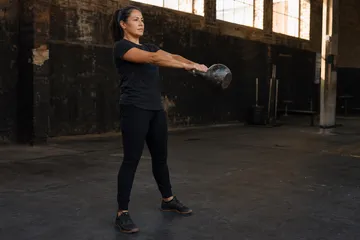 The 10,000-Swing Challenge: A Month of Volume Plan 10,000 kettlebell swings as 20 sessions of 500, with clear set clusters, weekly scheduling, bell selection, and tracking.
 -
 The Daily Swing and Get-Up Practice Organize 100 one-arm swings and 10 Turkish get-ups into a repeatable session with clear pacing, bell choices, and progression rules.
 -
 Kettlebell Swings by Time vs. Swings by Reps Choose timed or rep-based kettlebell swing sets by deciding whether pace, exact volume, technique, or session length matters most.