
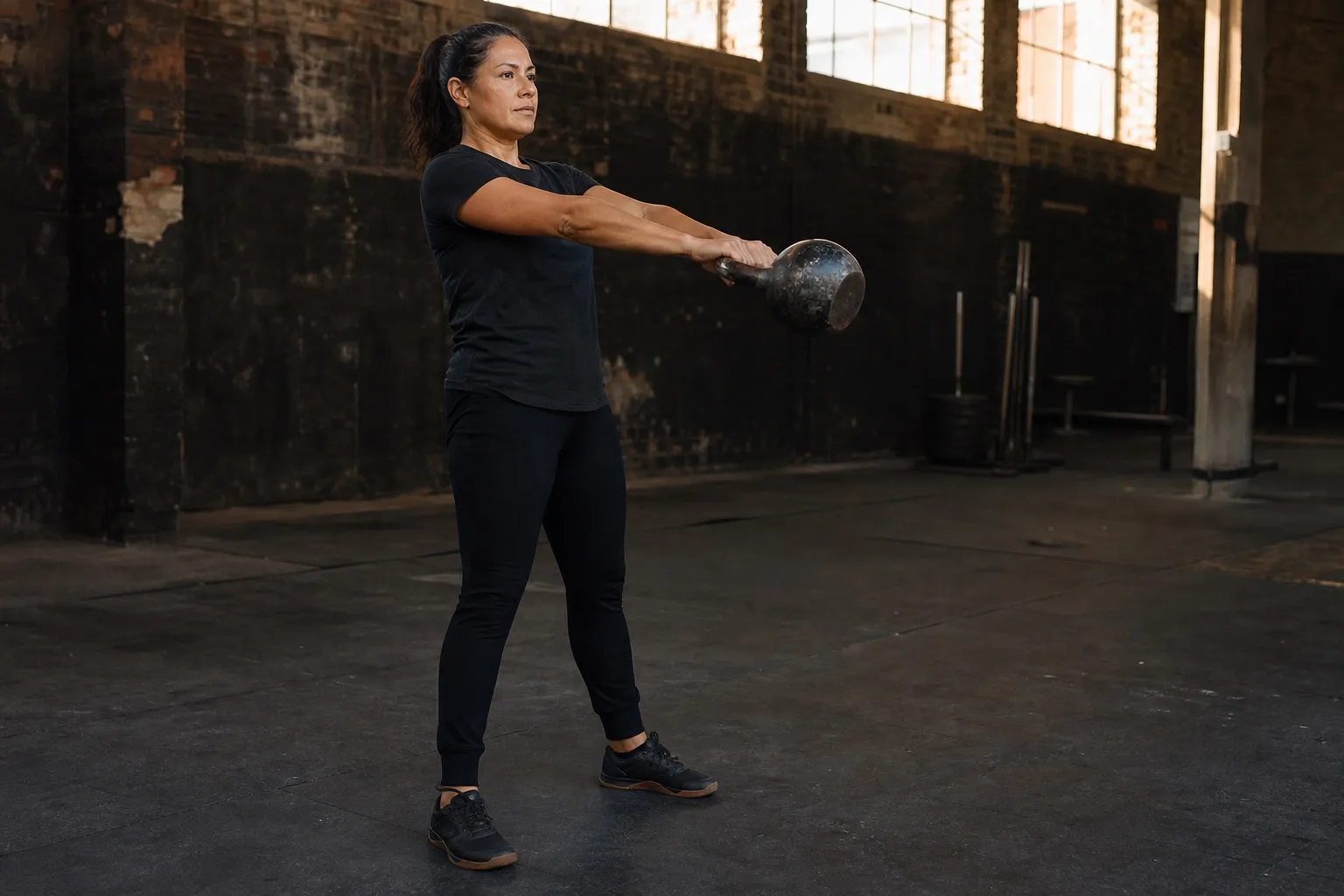
The 10,000-swing challenge is a finite high-volume training block: 500 kettlebell swings per session for 20 sessions.
The arithmetic is the whole premise:
500 swings × 20 sessions = 10,000 swings
To finish in four weeks, you need five sessions each week. At four sessions per week, the same plan takes five weeks. Both schedules reach the total; only one fits the “month” headline.
This is not a learn-the-swing plan. Five hundred repetitions expose every inconsistency in your setup, grip, breathing, and pacing. You should already have a repeatable swing and a recent record of sessions large enough to make this block a deliberate step rather than a guess.
Build 500 swings from five 100-rep clusters
The standard session structure is five passes through four sets:
- 10 swings
- 15 swings
- 25 swings
- 50 swings
Those four sets total 100. Repeat the cluster five times to reach 500.
| Cluster | Sets | Running total |
|---|---|---|
| 1 | 10, 15, 25, 50 | 100 |
| 2 | 10, 15, 25, 50 | 200 |
| 3 | 10, 15, 25, 50 | 300 |
| 4 | 10, 15, 25, 50 | 400 |
| 5 | 10, 15, 25, 50 | 500 |
The small sets at the beginning of each cluster let you settle back into the movement. The set of 50 is where pacing and bell choice become decisive. If 50 continuous swings changes the movement, split that rung into smaller sets such as 25 and 25. The daily total remains 500, but the session now matches work you can actually repeat.
Do not hide the split in your log. A set of 50 and two sets of 25 create different pacing demands even though both add 50 repetitions to the counter.
Choose the bell for repetition 500
The right bell is not the heaviest one you can swing for 10 repetitions. It is one you can handle after several hundred repetitions without changing the basic movement.
Use your recent history. If your normal session contains 100 swings, jumping directly to five times that amount also multiplies the opportunities for grip fatigue and rushed repetitions. Build larger sessions first, or choose a lighter bell than you use for lower-volume work.
Keep the bell stable during the first session so the result is readable. If you change weight, record exactly where it happened. A planned lighter bell for the final clusters is more useful than pretending all 500 repetitions were performed with the starting weight.
Review two-hand swing setup and mechanics before the block begins. The challenge rewards a consistent hinge and close backswing; it does not provide enough attention for rebuilding them during the longest set.
Schedule the work before you start
A four-week layout can be as plain as five training days followed by two non-swing days, adjusted to fit your week:
| Week | Sessions | Weekly swings | Running total |
|---|---|---|---|
| 1 | 5 | 2,500 | 2,500 |
| 2 | 5 | 2,500 | 5,000 |
| 3 | 5 | 2,500 | 7,500 |
| 4 | 5 | 2,500 | 10,000 |
Avoid scheduling the five sessions by accident. Put them on the calendar before day one and leave room to move a session when life interrupts. If you miss a day, continue from the next incomplete session. Doubling to 1,000 swings to protect the calendar changes the plan much more than extending the finish date.
Four sessions per week may fit your training history and schedule better:
- Week 1: sessions 1-4
- Week 2: sessions 5-8
- Week 3: sessions 9-12
- Week 4: sessions 13-16
- Week 5: sessions 17-20
The counter matters more than forcing the work inside an arbitrary month.
Rest enough to preserve the next set
There is no prize for making 500 swings one continuous race. Rest between sets. Rest longer after each 100-rep cluster. Begin the next set when you can repeat the setup and backswing you intended to train.
A practical first pass is 30 to 60 seconds after the sets of 10, 15, and 25, then 2 to 3 minutes after the set of 50. Adjust from the evidence in front of you. If your grip, stance, or swing height changes sharply, the useful response is more rest, a smaller set, a lighter bell, or the end of that day’s work.
Track total session time, but do not let the clock turn every workout into a test. In the early sessions, your goal is to learn how the volume is distributed. Later, comparable completion times can show whether the same bell and set structure are becoming more familiar.
Optional strength work should stay optional
Some versions place a strength movement between swing sets. You might use a press, goblet squat, row, or push-up for a few controlled repetitions. That can create a fuller session, but it also adds fatigue to a block that already contains 10,000 hinges.
If you include another movement:
- choose one you already know;
- keep the repetitions well below a difficult set;
- use the same movement and rep plan long enough to compare sessions; and
- log it separately from the swings.
You do not need filler after every set. One small strength set between clusters is easier to evaluate than adding work after all 20 swing sets. The swing total is the fixed part of the challenge. Everything else is negotiable.
Decide in advance what counts
Clear counting rules prevent the total from becoming fiction late in the block.
Count a repetition when you complete a normal swing and return the bell under control. Do not count a deadlift used to start or park the bell. If you stop a planned set of 50 at 37, record 37. The next set begins from zero; you do not need to rename it “the remaining 13” unless that note helps you understand the session.
Also decide whether you will use two-hand swings, one-arm swings, or a planned mix. Two-hand swings make the left-right question disappear. One-arm swings require you to record sides so 10,000 total repetitions do not conceal a large imbalance. The comparison of one-arm and two-arm swings can help you choose one version for the block.
Track the block at three levels
A useful challenge tracking record shows:
- Set level: repetitions, bell, and side when relevant.
- Session level: completed swings, total time, and any planned changes.
- Block level: sessions finished and cumulative swings toward 10,000.
Pood’s structured program records the 10-15-25-50 clusters while the workout history preserves what you actually completed. The cumulative counter gives the block a clear finish without erasing shortened sets, bell changes, or a session that ended early.
At the end, compare the first, tenth, and twentieth sessions. Look at bell weight, set splits, total time, and notes. The value of a finite challenge is not merely reaching a large number. It is producing 20 comparable records that show what happened between the first 500 swings and the last.
Then stop the block. Ten thousand is a finish line, not a permanent weekly quota. Review the record, return to a lower-volume structure, and decide what—if anything—the month earned next.