

Count repetitions when you want to control exactly how many swings you perform. Use time when you want to control how long you work or when each set begins. Neither method is inherently harder, and neither is automatically better for conditioning, strength, or technique.
The difference is what the prescription holds constant.
- Rep-based: the number of swings is fixed; set duration and rest can vary.
- Timed: the work or interval duration is fixed; the number of swings can vary.
That distinction matters because “100 swings” and “10 minutes of swings” do not describe interchangeable sessions. The better choice is the one that makes your current training question easier to answer.
Reps give you exact volume
A rep-based prescription might read:
10 sets of 10 two-hand swings with 60 seconds between sets.
You know before starting that the session contains 100 swings. If the bell stays the same, the planned load-volume calculation also stays the same: 100 repetitions multiplied by the bell weight.
This makes reps useful when you want to:
- learn the movement in short, deliberate sets;
- repeat the same workload from session to session;
- complete a finite volume target;
- compare rest time at the same bell and rep count; or
- divide one-arm work evenly between left and right.
Rep targets also give each set a firm stopping point. Ten clean repetitions remain ten even if they take 16 seconds today and 19 seconds next week. That can help you keep the technical standard ahead of the clock while learning. If the hinge and float are not yet repeatable, start with the two-hand swing guide before adding time pressure.
The limitation is that reps alone say nothing about pace. Ten sets of ten with 30 seconds of rest and ten sets of ten with two minutes of rest contain the same swing count, but they are not the same session. Record the rest plan or total duration alongside the repetitions.
Time gives you a fixed container
A timed prescription needs two numbers, not one:
10 rounds of 20 seconds of swings, followed by 40 seconds without swings.
The whole session lasts 10 minutes. The clock controls the work window and the next start. Your swing count is an outcome.
This format is useful when you want to:
- fit training into a known amount of time;
- practice a steady, repeatable rhythm;
- organize work and recovery without watching an open-ended rest timer;
- observe whether repetitions fall across equal work periods; or
- coordinate alternating sides on a fixed schedule.
Time does not mean “perform as many reps as possible.” A 20-second window can contain controlled, repeatable swings without becoming a sprint. Decide before the session whether you will move at a steady rhythm or stop early when the next repetition would be rushed.
For a clock that starts work every minute, the kettlebell EMOM guide explains how to leave enough time to park the bell and prepare for the next set. That structure fixes the interval start, while the work inside it can still be prescribed by reps.
The methods can overlap
Many useful sessions combine a rep target with a time rule. “Ten swings every minute for 10 minutes” fixes all three of these:
- 10 repetitions per set;
- one set starts each minute; and
- 10 total rounds.
That produces exactly 100 swings in 10 minutes. The remaining seconds after each set become recovery time.
By contrast, “20 seconds of swings every minute for 10 minutes” fixes the work duration but not the total reps. If you perform 11 swings in the first window and 9 in the last, the session totals 100 only by coincidence.
Use the hybrid version when exact volume and a repeatable schedule both matter. Use open timed windows when cadence or rep stability is the information you want to observe.
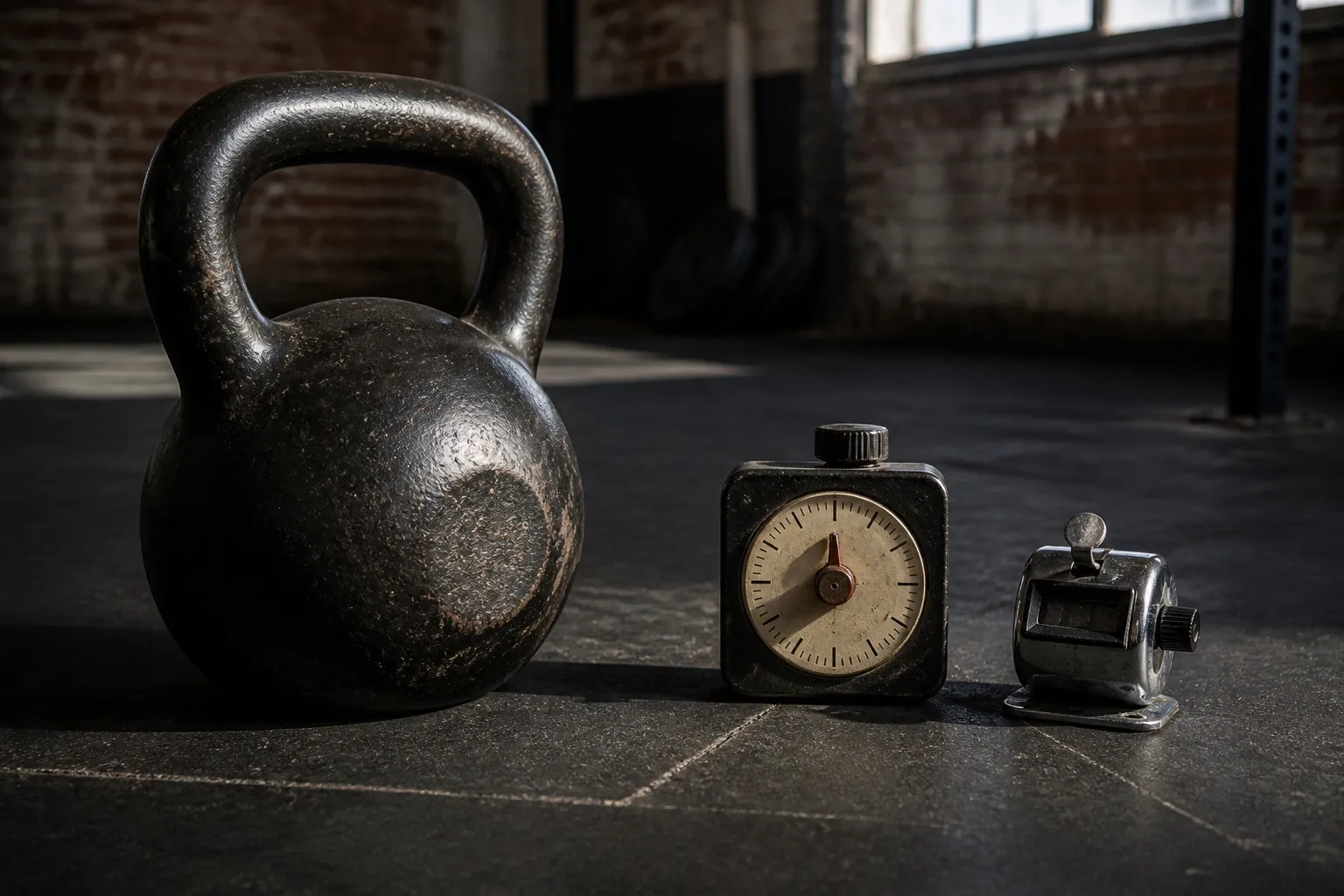
Compare the two without confusing the variables
Start with the question, then choose the format.
| Your question | Better starting format | What to record |
|---|---|---|
| Can I repeat 100 crisp swings? | Reps | Sets, reps, bell, rest, total time |
| Can I keep the same pace for 10 minutes? | Timed | Work/rest intervals, reps per round, bell |
| Is my rest shrinking at the same workload? | Reps plus a rest timer | Sets, reps, bell, rest between sets |
| Do my reps fade across equal windows? | Timed | Reps in every work window, not only the total |
| Are both sides getting equal work? | Either | Separate left and right counts |
Do not change the bell, reps, rest, and session length together, then credit the format for the result. If you move from 10 sets of 10 with open rest to 20-second maximum-effort windows, you changed the pace rule as well as the counting method.
A small laboratory comparison illustrates the problem. Fourteen young adults performed the same total number of swings in two formats: eight condensed 20-second work periods with 10-second breaks, or four rep-based sets with 90-second breaks. The condensed format took less than half the total time and produced higher reported effort and metabolic demand. The swing count matched; the schedule did not. The study does not establish a universal best format, but it shows why total reps cannot describe the whole session.
Keep one-arm work unambiguous
Timed one-arm swings create a side-accounting problem unless you define the switch rule.
Three clear options are:
- Alternate sides each round and use an even number of rounds.
- Split each work window evenly, such as 10 seconds left and 10 seconds right.
- Give each side its own complete block, using the same number of rounds and the same interval.
The first option usually makes the cleanest record. Twelve one-minute rounds with alternating sides give each side six exposures. Eleven rounds do not. If you deliberately use an odd number, note the starting side and reverse it next time.
Rep-based one-arm work has its own ambiguity. “10 one-arm swings” could mean 10 total or 10 per side. Write 5 left + 5 right or 10 per side. The one-arm and two-arm swing comparison covers when that side-specific work is worth adding.
Progress the variable the format exposes
For rep-based training, a progression might add sets while holding reps, bell, and rest steady:
- 5 sets of 10.
- 6 sets of 10.
- 8 sets of 10.
- 10 sets of 10.
For timed training, add rounds while keeping each work and recovery window unchanged:
- 6 rounds of 20 seconds on, 40 seconds off.
- 8 rounds at the same schedule.
- 10 rounds at the same schedule.
Only after the longer session remains consistent should you consider changing the bell, work window, or recovery. Progressing one edge at a time leaves a readable trail. The guide to training volume explains what changes when reps or bell weight rise, and why time belongs beside that number rather than inside it.
Log both the prescription and the result
For a rep-based session, record:
- swing variation and side;
- bell weight;
- sets and reps;
- planned or actual rest; and
- total session time when it matters.
For a timed session, record:
- work and recovery durations;
- number of rounds;
- repetitions in each round;
- swing variation, side, and bell; and
- any round you shortened or skipped.
Pood keeps the rep count, bell, side, and interval schedule attached to the workout. Its interval blocks can start rounds on a repeating clock, while rep-based sessions keep the rest timer visible between sets. That lets the history preserve what you prescribed and what you completed.
Choose reps when exact work is the anchor. Choose time when the schedule is the anchor. Combine them when you need both. Then log enough detail that next week’s version is a decision, not a reconstruction.