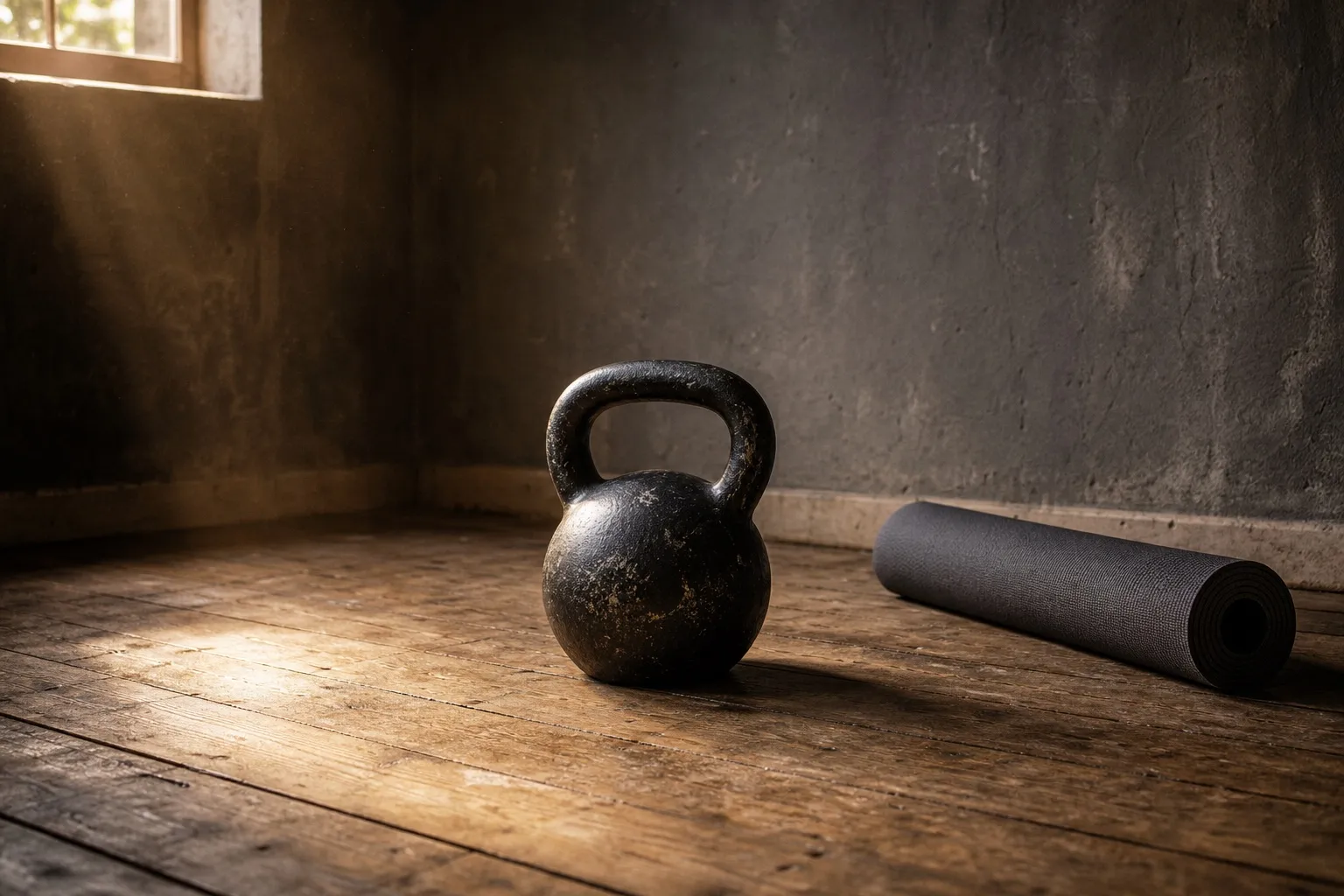
A one-kettlebell home gym is not a complete commercial gym compressed into one object. It is a small, repeatable training setup built around the bell you own.
One bell can cover hinges, squats, presses, rows, carries, and floor work. It cannot be the perfect load for every movement. The useful skill is knowing when to change the exercise, the repetitions, or the rest instead of forcing one weight to do a job it does not fit.
You need less space than you think:
- one kettlebell;
- a clear patch of floor long enough to lie down on;
- enough overhead clearance for any movement you plan to perform standing;
- a surface that gives your feet reliable traction; and
- a timer or training log.
That is a home gym if you use it consistently.
Choose the bell for the hardest movement
Your hips can usually move more weight than one arm can press. That creates the central compromise of owning one bell: a satisfying swing weight may be too heavy overhead, while an easy press weight may feel light for two-hand swings.
Choose around the movement with the narrowest margin. If presses and get-ups are central to your plan, the bell must be controllable there. You can make a lighter bell more demanding for squats and hinges, but you cannot negotiate a bell into being lighter when it is already overhead.
If your plan is mostly two-hand swings, deadlifts, goblet squats, and carries, a heavier bell may be appropriate because the one-arm overhead problem matters less. If the bell has to do everything, start with the practical ranges in the beginner kettlebell sizing guide and test the actual weight before buying.
Handle comfort matters too. A bell you use for two-hand swings needs enough window space for both hands, while one-arm work depends on how the body rests against your forearm. The cast-iron and competition-style comparison explains those differences.
Build a movement menu, not a giant exercise list
You do not need 30 variations. Pick one dependable movement from each job your training needs.
| Training job | One-bell options | Load check |
|---|---|---|
| Hinge | Deadlift, two-hand swing | Bell should move without changing your back position |
| Squat or lunge | Goblet squat, reverse lunge | You should control the bottom and stand without twisting |
| Push | One-arm press, floor press | Wrist stays straight; both sides use clean repetitions |
| Pull | One-arm row | Torso stays stable rather than rotating to lift the bell |
| Carry | Suitcase carry, front-rack carry | You can walk without leaning away from the load |
| Ground transition | Get-up practice | Every position remains deliberate and repeatable |
Bodyweight work fills gaps without adding equipment. Push-ups can supply more pressing volume when the bell is too heavy for repeated overhead sets. Walking, crawling, and unloaded mobility can sit between bell sessions. Minimal equipment does not require every exercise to involve the kettlebell.
Start with movements you already know. A compact setup rewards repetition, because you can practice the same few lifts often enough to notice what is improving. It does not make advanced combinations safer to learn alone.
Three simple ways to organize a session
The bell does not dictate the workout. Sets, repetitions, and rest create the structure.
A full-body circuit
Choose one squat, one push, one pull, and one carry. For example:
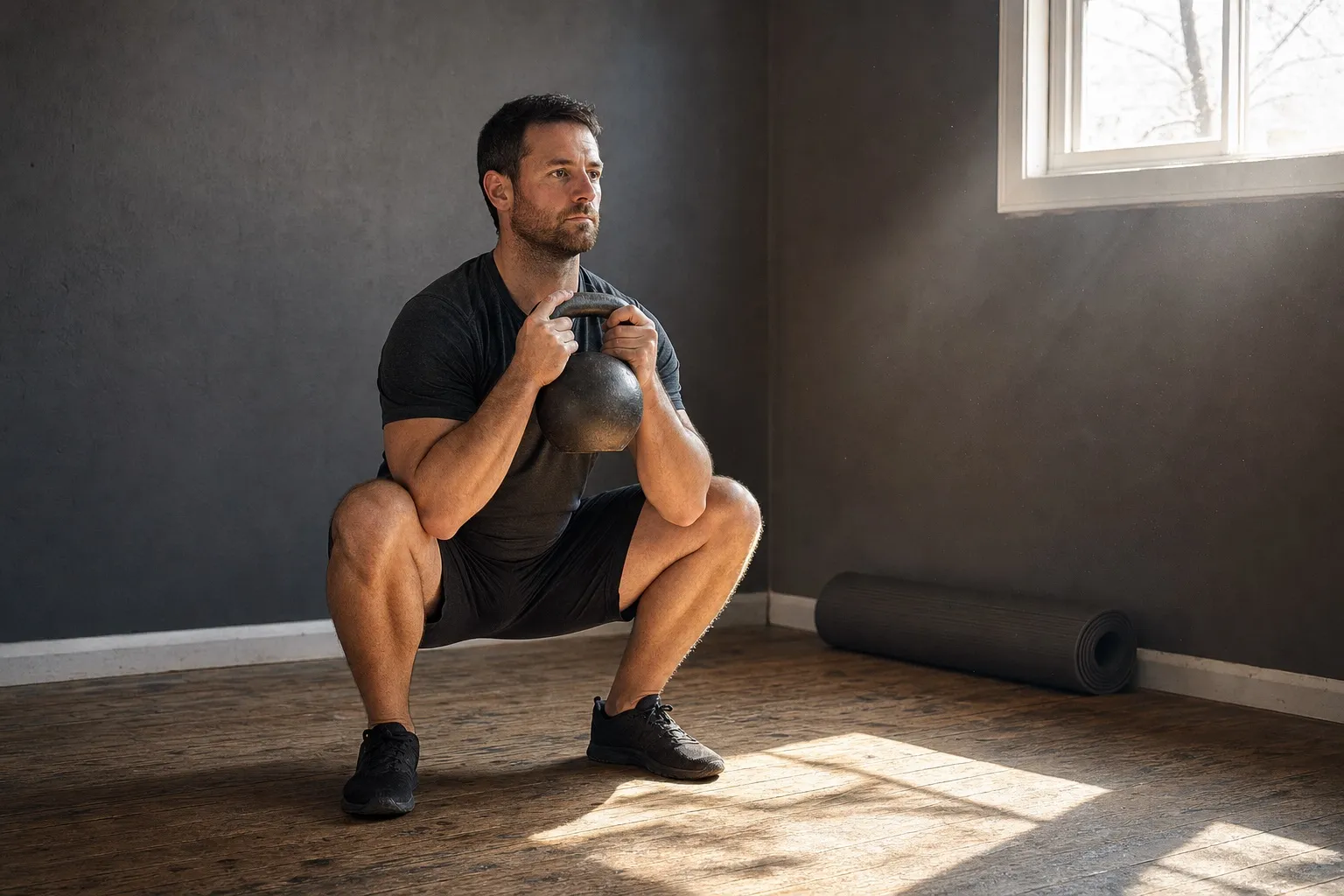
- Five goblet squats.
- Five one-arm floor presses per side.
- Eight one-arm rows per side.
- A 20- to 30-second suitcase carry per side.
- Rest 60 to 90 seconds.
Repeat for three to five rounds. Keep the first round conservative. If one movement is much harder than the others, lower its repetitions rather than letting it degrade the entire circuit.
A hinge-focused session
Perform 10 two-hand swings, set the bell down with control, and rest until you can repeat the set with the same timing and position. Six to 10 sets gives you 60 to 100 total swings without inventing a complicated format. If the movement is still new, learn the swing setup, hinge, and return before using it for a higher-volume session.
Rest may be 45 seconds on one day and 90 seconds on another. The target is repeatable work, not an arbitrary race. If you have not learned the swing, use deadlifts while you get instruction on the hinge and bell path.
Alternating timed blocks
Set a repeating one-minute timer. On the first minute, perform six goblet squats. On the second, perform five rows per side. Continue alternating for 10 minutes, resting for whatever remains in each minute.
Adjust the repetitions before starting so each block leaves real rest. The timer should organize the session, not pressure you into rushed reps.
These examples are templates, not mandatory programs. Change the movement when the bell does not suit it. Keep the structure when it helps you begin without deliberating for 20 minutes.
Progress without adding weight
A heavier bell is only one progression tool. With a fixed load, you can make the same equipment support months of useful training.
Change one variable at a time:
- Add repetitions. Move from sets of five to sets of six while keeping the number of sets and rest stable.
- Add a set. Keep each set the same and increase total work.
- Improve the movement. Use a more consistent depth, a quieter setup, or a cleaner rack position.
- Reduce rest slightly. Cut 10 to 15 seconds only when the work remains unchanged.
- Use one side at a time. A suitcase carry or single-arm row can make a moderate bell more demanding without increasing its weight.
- Slow controlled lifts. Pauses and slower lowering can change squats, lunges, rows, and presses. Do not turn a swing into a slow lift; choose a different hinge variation instead.
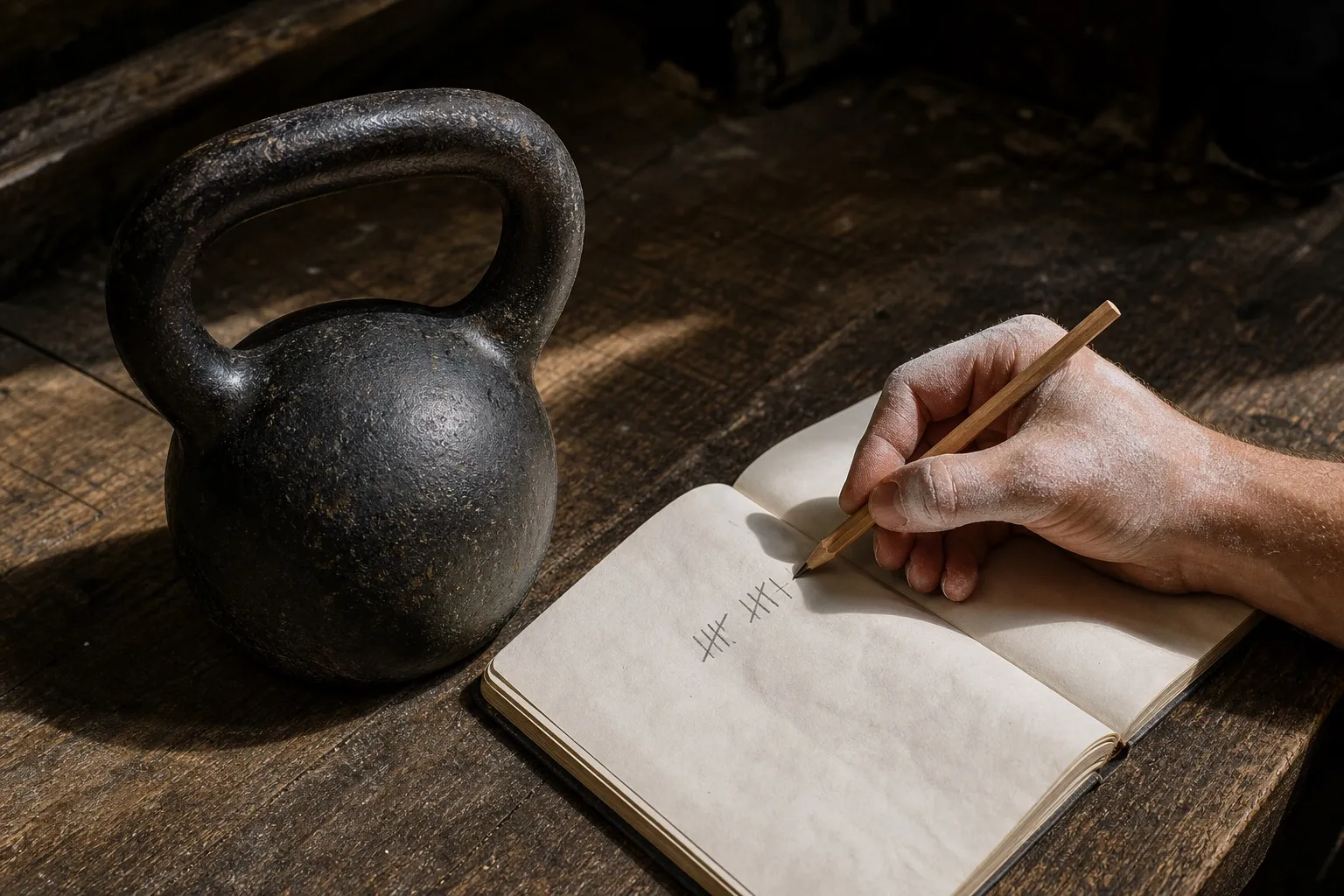
Write down what you changed. If repetitions, sets, rest, and exercise difficulty all move at once, you cannot tell which change produced the result—or which one caused the session to fall apart.
When the bell is too heavy or too light
If the bell is too heavy for a movement, do not turn every repetition into a test. Use it for the lifts it fits, reduce the repetitions, or substitute a bodyweight movement. A bell that works for deadlifts and squats can wait on the floor during push-ups.
If it is too light, first make the existing work more deliberate. Add total repetitions, shorten rest modestly, use unilateral movements you already perform well, or add a pause to controlled strength lifts. More complexity is not automatically more productive.
The bell has become genuinely limiting when the reasonable adjustments no longer match your goal. Endless squat repetitions are not a good substitute for a heavier strength load. A light press bell may never become a satisfying two-hand swing bell, no matter how creative the circuit becomes.
That is when another weight solves a real problem.
What should the second bell be?
Your log should answer that question better than a shopping chart.
Add a heavier bell when your hinge and squat work remain crisp at higher repetitions but no longer ask enough of you. Add a lighter bell when the current weight blocks overhead practice or controlled get-ups. Buy a matching bell when double-bell training is the specific next step—not merely because matching pairs look complete.
The second bell does not have to be the next traditional 4 kg jump. A 2 kg step or an adjustable bell can make sense when the larger jump changes your technique. Buy the missing capability, not the shape of an imagined collection.
Pood lets you register the bell you own and log it in kilograms, pounds, or poods. Track the exercise, sets, repetitions, and rest. After enough sessions, the pattern becomes visible: which movements have room to grow, and which keep running into the same load limit.
One kettlebell is enough to start. A clear floor, a short movement menu, and a written record turn it into a gym.