
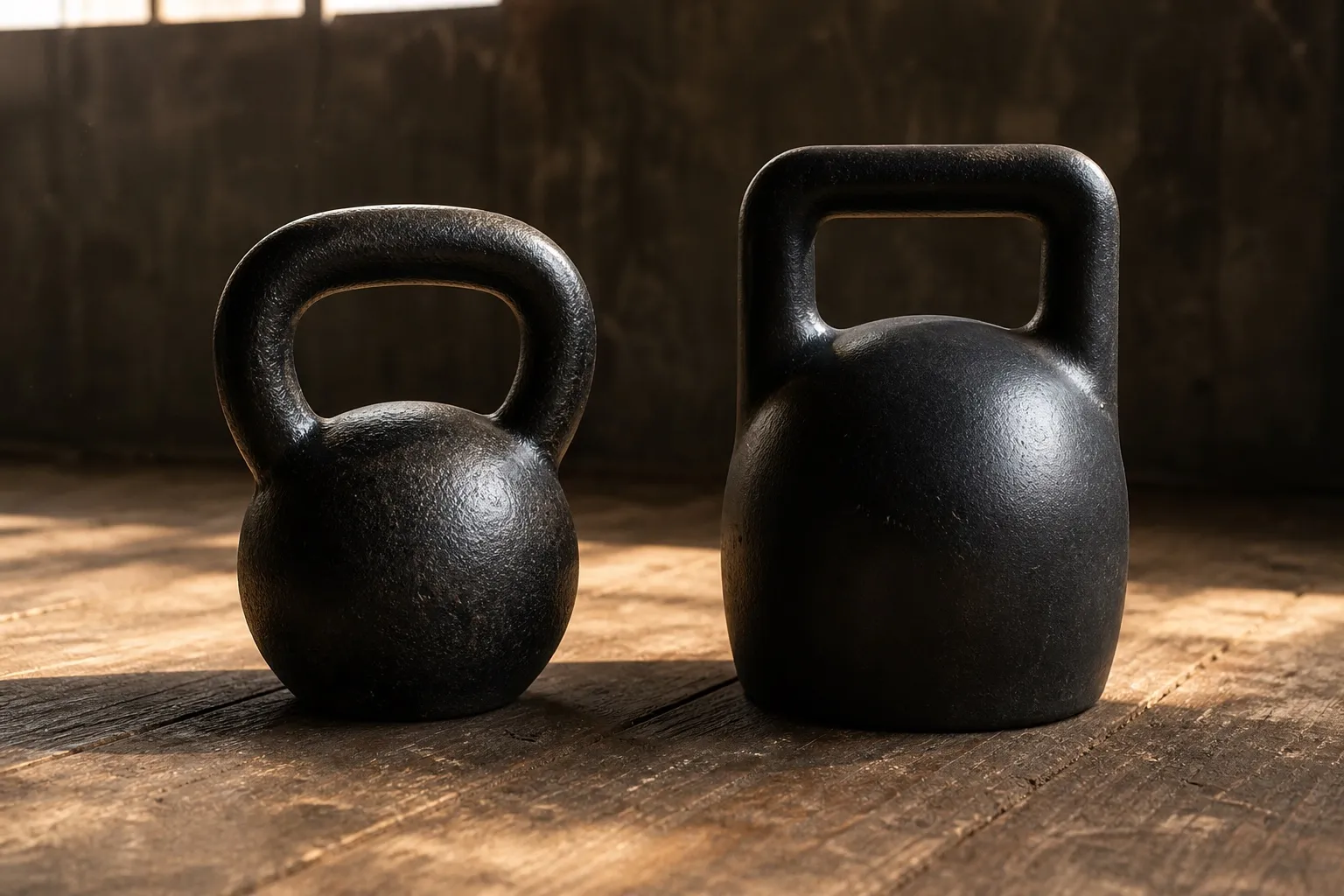
Cast-iron and competition kettlebells can train the same movements. The meaningful difference is not what you can do with them. It is how the bell fits your hands and forearms, how that fit changes across weights, and what the body takes up on your floor.
The short answer:
- Buy cast iron if you want a compact, straightforward bell for swings, deadlifts, squats, carries, and general strength work. It is usually the practical first choice for a home gym.
- Buy competition style if you expect to do many cleans, snatches, or long one-arm sets and want every weight to meet your hand and forearm in the same place.
- Try both before deciding if possible. Handle shape and window size vary enough between makers that the category alone cannot tell you what will feel right.
Neither style is an upgrade from the other. They solve different fitting problems.
The main difference is size
A traditional cast-iron kettlebell gets larger as it gets heavier. An 8 kg bell has a small body; a 32 kg bell has a much larger one. The handle diameter and the space inside the handle may change too, depending on the maker.
A competition-style kettlebell keeps the same outer dimensions across its weight range. A light bell and a heavy bell use the same-size shell and handle. The maker changes the amount or distribution of metal inside rather than enlarging the outside.
That consistency is the point. When you move from 16 to 20 kg, the bell should land in nearly the same place in the rack position. Your hand insertion and overhead position do not have to adapt to a new body size.
The tradeoff appears at the light end. An 8 or 12 kg competition bell is still full-sized. It can feel bulky against a smaller forearm, and it occupies more floor space than a cast-iron bell of the same weight.

Handles change the experience
Cast-iron bells commonly have a wide, curved window that gives two hands plenty of room. That makes them comfortable for two-hand swings, goblet squats, and deadlifts. Heavier models often have thicker handles, which can turn ordinary sets into more grip work.
Competition handles are designed around repeatable one-hand use. They tend to have a more rectangular window and a consistent diameter across weights. The bare or lightly finished gripping surface also works well with chalk during longer sets.
Those traits do not guarantee comfort. A rectangular window may feel cramped when you place both hands on it, especially if your hands are large. The full-size shells can also crowd each other during double-bell swings and cleans. Conversely, a poorly shaped cast-iron window can pinch the heel of your hand or force the bell to sit awkwardly on your forearm.
Do not shop from a product photo alone. Look for published measurements for:
- handle diameter;
- usable handle width;
- space from the underside of the handle to the bell body;
- overall bell width and height; and
- base diameter.
A few millimeters at the handle can matter more than the finish color.
Which style fits your training?
| Your priority | Better starting point | Why |
|---|---|---|
| Two-hand swings and general strength work | Cast iron | Broad handle options and a compact body at lighter weights |
| Cleans, snatches, and long one-arm sets | Competition style | Consistent hand, rack, and overhead geometry |
| Several bells in a small room | Cast iron | Lighter weights usually occupy less space |
| Technique that should feel identical after a weight change | Competition style | Outer dimensions remain consistent |
| Double-bell work | Try before buying | Competition shells can feel wide; cast-iron pairs change size with load |
| Floor-supported movements | Check the base, not the category | A broad, flat base matters more than the label |
If most of your week is swings, squats, presses, and carries in moderate sets, a well-made cast-iron bell gives up very little. If you organize sessions around repeated cleans and snatches, the consistent competition shape becomes more valuable. Bell geometry changes the contact point, but a close clean path and well-timed hand insertion matter with either style.
Beginners do not automatically need cast iron, and experienced lifters do not automatically need competition bells. Start with the movements you will actually practice. If you have not settled on a load yet, choose that first with the beginner kettlebell sizing guide. Style comes after usable weight.
Construction and finish matter more than the category
Both types can be excellent or badly made. Inspect the individual bell rather than assuming a name guarantees quality.
Run your fingers around the underside and sides of the handle. You are looking for a continuous surface without a raised casting seam, sharp ridge, flaking coating, or filled defect. Small cosmetic marks are normal. Anything that repeatedly catches skin is not.
Set the bell on a hard, level floor. The base should sit flat without rocking. Check where the handle meets the body for cracks, rough joins, or gaps. Some bells use one-piece construction; others use welded components. Either approach depends on execution, so judge the actual joint and the maker’s warranty rather than relying on one construction phrase.
The best handle finish depends on your training and environment:
- A lightly textured coating can feel secure without chalk and helps protect the metal.
- A smooth or bare handle permits small grip adjustments and accepts chalk well.
- A thick, glossy coating can become slippery and may hide rough work underneath.
If you train in a humid garage, exposed metal will need occasional attention. Wipe away moisture and chalk after use, and address surface rust before it becomes rough.
You can mix styles
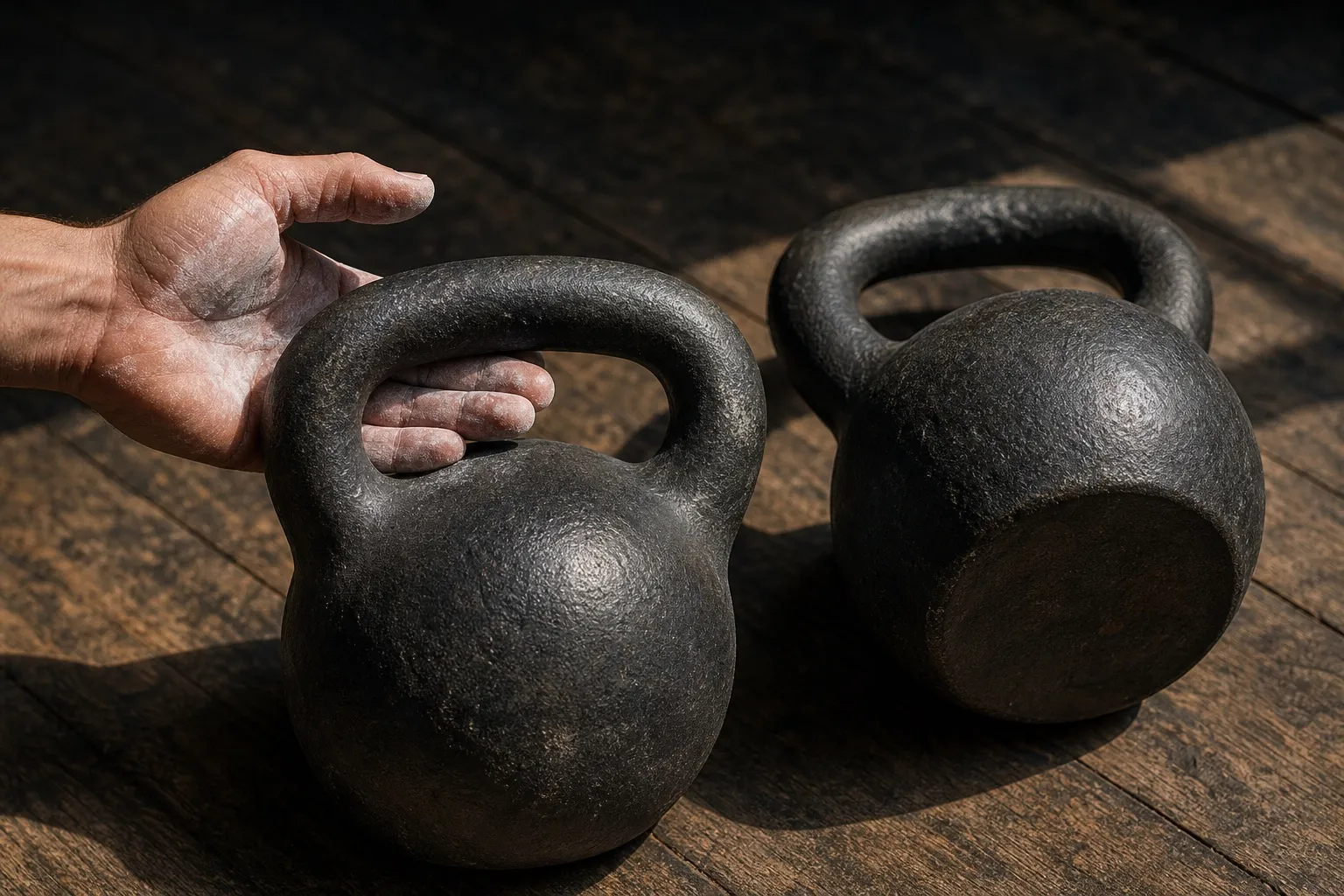
There is no training rule that says every bell in your collection must match. A compact cast-iron bell can serve two-hand swings while a competition bell handles longer one-arm work. You can also own neighboring weights from different makers.
The adjustment is simply more noticeable. A 16 kg cast-iron bell and a 20 kg competition bell may differ in handle thickness, window shape, balance, and where the body contacts your arm. Give yourself a few careful sets when changing between them instead of assuming the heavier bell is the only new variable.
If consistency matters, buy a matched style before you buy a matched color. This is especially useful when building a pair for double-bell training or a progression from one weight to the next. Traditional kettlebell sizes often rise in 4 kg steps because of their relationship to the old pood-based sizing pattern, but many lines now offer smaller jumps.
A practical buying test
When you can handle a bell before purchasing, use the same short test for either style:
- Put both hands on the handle. Your little fingers should not be forced against the corners.
- Hold the bell in the rack position on each side. It should rest on the forearm without driving one hard edge into a single spot.
- Press it only if the weight is already appropriate for you. Notice whether the handle lets your wrist stay straight.
- Perform a few controlled swings. The handle should not pinch as your grip closes.
- Set it down and check the base for rocking.
When buying online, compare dimensions and return terms before comparing minor cosmetic features. Shipping a kettlebell back can erase the savings from a lower price.
The decision
Choose cast iron when you want compact simplicity and your training is built mostly around two-hand and general strength movements. Choose competition style when consistent geometry and one-hand comfort matter enough to justify a larger shell.
Then stop shopping and train. Register the bell you actually bought, record its real weight, and let repeated sessions tell you what the next purchase should solve. Pood keeps your bell list and lets you log in kilograms, pounds, or poods, so mixed styles and mixed markings do not turn into a bookkeeping problem.
The better kettlebell is the one whose handle, window, and body disappear from your attention while you use it.