
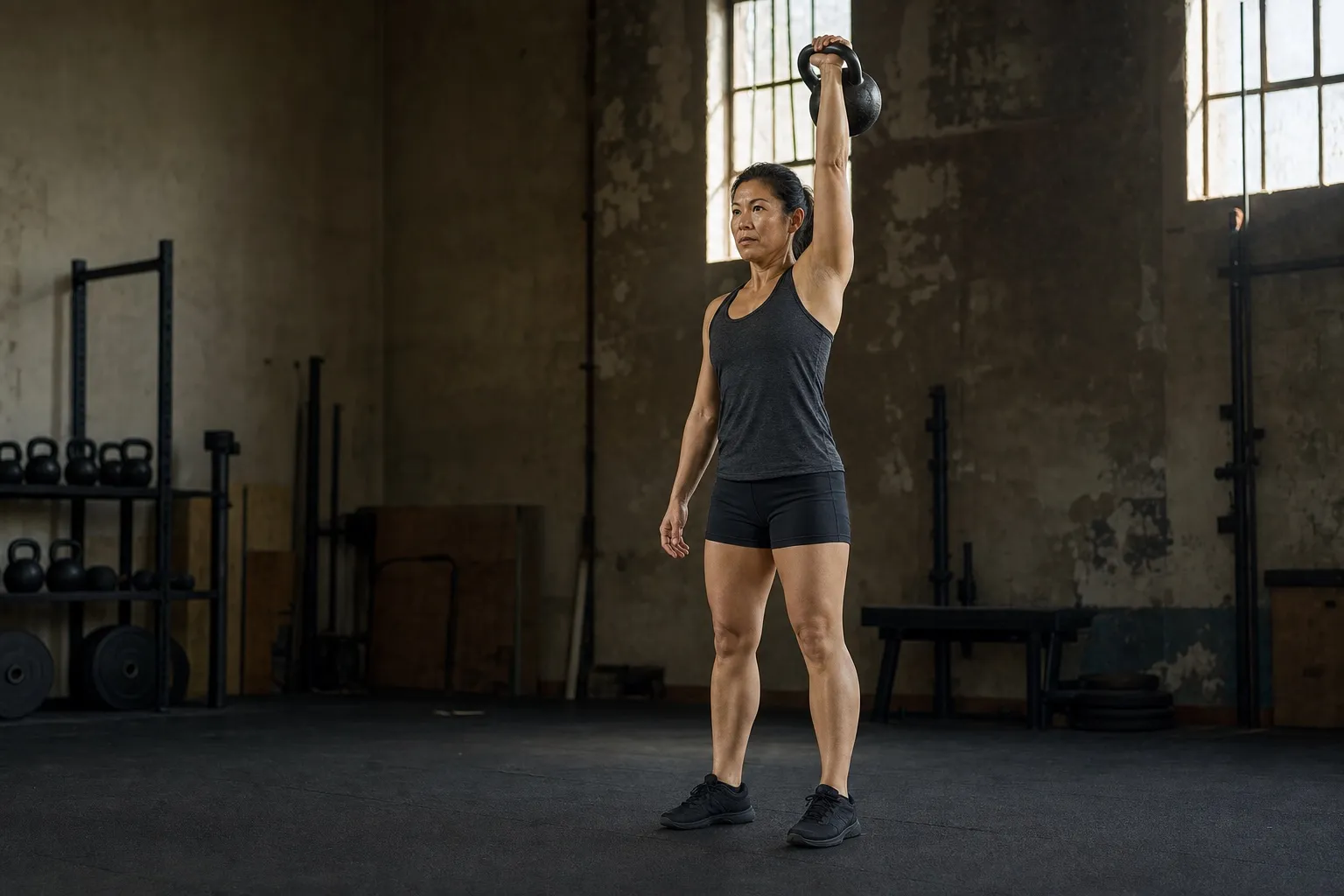
A strict kettlebell press starts with the bell settled in the rack and ends with it balanced overhead. Your legs stay straight. Your torso stays organized. The working arm moves the bell through the space between those two positions without a kick from the knees or a large backward lean.
The movement is simple, but the bell makes the details matter. Its weight sits behind your hand instead of directly above it. That offset asks you to keep the wrist, elbow, shoulder, and trunk working together throughout the repetition.
Start lighter than you think. The best first press is not the heaviest bell you can force overhead. It is a repetition you can pause in the rack, guide through a consistent path, and hold still at the top.
Begin with a rack you can own
The press starts before the bell moves. Stand with your feet about hip- to shoulder-width apart and place the bell in the rack. The handle runs diagonally across the palm, the wrist stays close to straight, and the bell rests against the forearm and upper arm. Keep the elbow near the ribs without squeezing it toward the middle of your chest.
You should be able to stand in the rack for several calm breaths. If the bell pulls your wrist backward or keeps bouncing against the forearm, work on a quieter kettlebell clean before adding the press. You can also use both hands to place a light bell in the rack while you learn the overhead portion.
Before each repetition:
- Stand tall with pressure across the whole foot.
- Keep the ribs over the pelvis rather than lifting the chest into a backbend.
- Brace the trunk and lightly tighten the legs and free hand.
- Look straight ahead and let the bell become still.
This creates a steady platform. The pressing arm then has one job instead of also trying to correct a moving torso.
Press up and slightly back
From the rack, begin driving the handle upward. The forearm should stay close to vertical beneath the handle instead of tipping far inside or outside the elbow. Let the elbow move away from the ribs as the bell rises.
The bell does not travel in a perfectly straight line from the rack. It begins beside your chest and finishes above your shoulder, so the path moves up and slightly back. Make that shift gradually. Do not swing the bell around your head or lean away to create space.
As the hand approaches eye level, allow the upper arm to rotate so the palm turns more forward. The bell continues around the outside of the forearm while the hand stays firmly connected to the handle. Keep the knuckles generally pointed upward and avoid letting the wrist fold back under the load.
Move around the bell, not away from it
The bell needs a clear path past your face. A small movement of the head is enough: draw the chin back slightly as the handle passes, then return the head to a neutral position as the arm reaches overhead.
Keep the rest of the torso quiet. A deep side bend or large backward lean may help a bell move, but it changes the exercise and makes the finish harder to balance. If you need to reshape your whole body around the weight, use a lighter bell.
Watch the knees as well. In a strict press they do not dip before the bell moves. A knee dip and leg drive make a push press, which is a useful movement with a different purpose. Be precise about which one you are practicing.
Finish in a stacked lockout
At the top, the handle should settle over the shoulder with the arm long and steady. The bell hangs behind the hand rather than pulling forward. From the side, the hand, shoulder, hip, and middle of the foot should form a mostly vertical stack.
Reach tall without shrugging aggressively or forcing the shoulder into an uncomfortable position. Keep the ribs down, the knees straight, and the feet planted. Pause for one second. If the bell continues drifting or you have to chase it with your torso, the repetition is not finished yet.
The overhead position should resemble the stable checkpoints in a Turkish get-up: a firm grip, a straight wrist, and a bell balanced above the supporting joints. The route is different, but the final control is shared.
Lower with the same attention
Do not let the bell fall from the lockout. Begin by pulling the elbow down while keeping the forearm beneath the handle. Let the palm rotate inward as the bell passes eye level, then guide the elbow toward the ribs.
The bell should return softly to the rack. Absorb the final part with the upper arm against the torso rather than catching it on a bent wrist. Pause, reset your stance and brace, and start the next repetition from stillness.
If you cleaned the bell for the set, return it through the backswing and park it after the final press. Avoid lowering a tired bell from the rack directly to the floor with one arm.
Fix the common press problems
The bell stalls just above the rack
Check the starting position. An elbow pulled far across the body makes it difficult to press upward. Let the forearm begin more vertically and keep the wrist stacked over the elbow. Reduce the load if the bell still cannot leave the rack without a lean.
The forearm tilts under the bell
Keep the hand over the elbow as the bell rises. If the hand moves inside while the elbow moves outside, the load no longer has a solid base. Slow the repetition and practice singles so you can see where the stack changes.
The lower back arches
Reset the ribs over the pelvis and tighten the legs before the press begins. Use a lighter bell if you cannot keep that position as the arm passes your face.
The knees dip without you noticing
Pause in the rack before every repetition. A visible moment of stillness makes it easier to separate a strict press from a leg-driven press.
The bell pulls forward at lockout
Finish with the hand above the shoulder rather than in front of it. Move the head gently through as the arm straightens and hold the top long enough to confirm balance.
A first press practice session
Prepare the shoulders, trunk, and rack position before pressing. The kettlebell warm-up guide offers a short sequence you can scale to the day.
Then use a bell you can press cleanly for at least five repetitions per side:
- Place or clean the bell into the rack and hold for 10 seconds per side.
- Press once, pause for one second overhead, and lower to the rack.
- Complete 5 single repetitions per side, resting as needed between sides.
- Rest 60–120 seconds.
- Perform 3 sets of 3 presses per side with the same controlled pauses.
Stop a set when the knees begin to dip, the torso leans, or the lockout stops settling. Those changes are more useful than an arbitrary rep target for deciding when the set is over.
For ongoing strength work, use 3–5 sets of 2–5 clean repetitions per side. Add a repetition to each set before moving to a heavier bell. Kettlebells often increase in large jumps, so a strong set of five does not always mean the next bell is ready for five. Return to singles or doubles with the new load and rebuild patiently.
Log the bell, repetitions, and side separately. Note whether the last repetition stayed strict. Pood keeps left and right work distinct, which makes it easier to see whether both sides are progressing without turning the session into a spreadsheet.
A good press looks settled at both ends. Own the rack, guide the bell through a narrow path, and make the overhead pause the standard every repetition has to meet.