
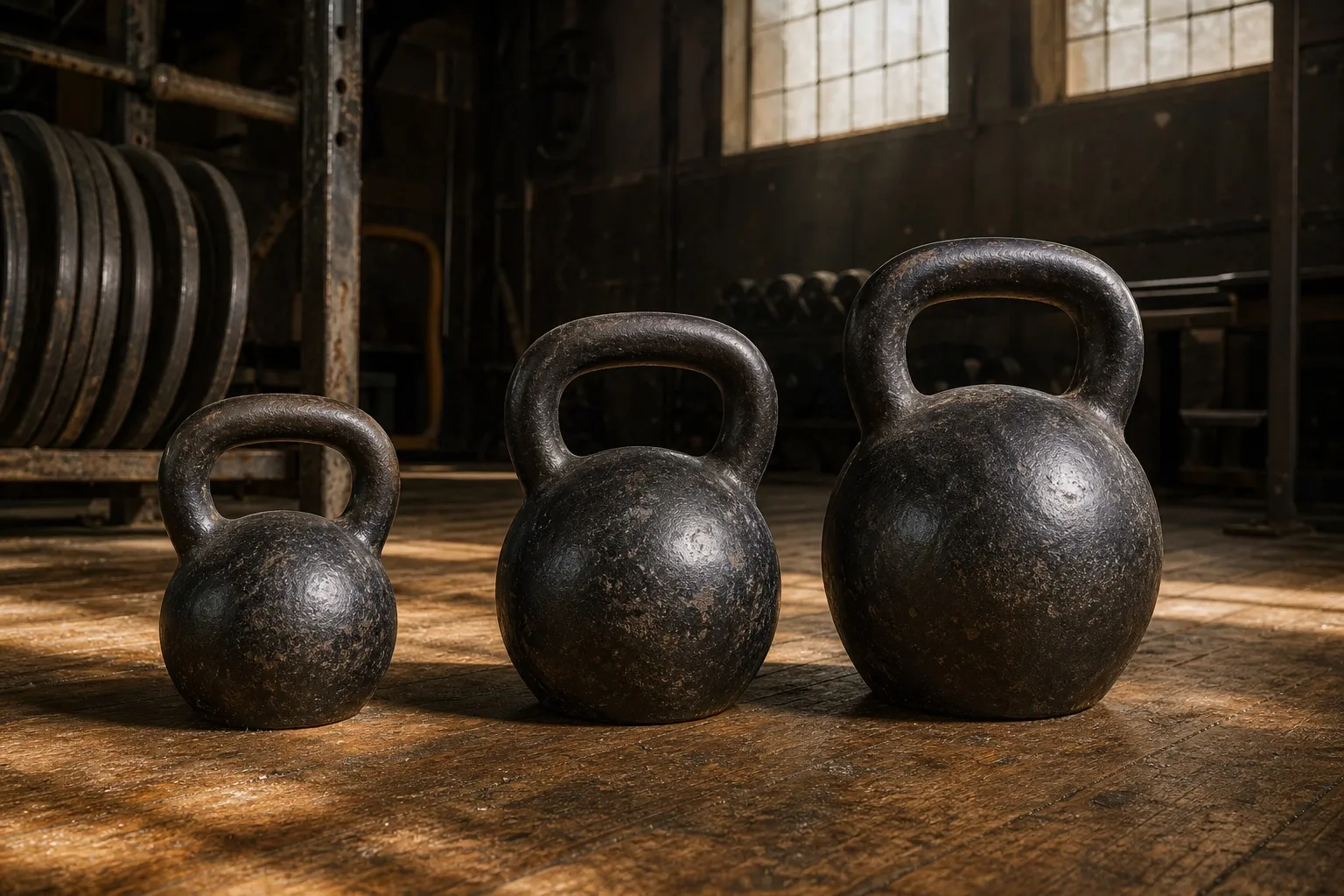
A pood is an old Russian unit of mass equal to about 16.38 kilograms, or 36.11 pounds. It is no longer a standard everyday unit, but its proportions still show up in the kettlebell rack.
That familiar sequence of 8, 12, 16, 20, 24, 28, and 32 kg is not arbitrary. Four kilograms is close to one-quarter of a pood. The most recognizable sizes land near clean fractions of the older unit:
| Modern kettlebell | Approximate poods | Traditional fraction |
|---|---|---|
| 8 kg (18 lb) | 0.49 | 1/2 pood |
| 12 kg (26 lb) | 0.73 | 3/4 pood |
| 16 kg (35 lb) | 0.98 | 1 pood |
| 24 kg (53 lb) | 1.47 | 1 1/2 poods |
| 32 kg (71 lb) | 1.95 | 2 poods |
The stamp on a modern bell is metric. The family resemblance is older.
One pood is not exactly 16 kg
This is the detail most quick definitions skip. A historical pood was about 16.38 kg, not 16 kg. A modern 16 kg kettlebell is therefore about 0.98 pood.
Calling it a one-pood bell is still useful. Kettlebell manufacturers settled on practical whole-kilogram sizes rather than reproducing an obsolete measure to the gram. The same rounding applies up the rack: 24 kg stands in for 1 1/2 poods, and 32 kg stands in for 2 poods.
Use the fractional names as a way to understand the sizing system, not as precision labels. If you are recording load or calculating training volume, use the actual weight stamped on the bell.

Why kettlebells move in 4 kg jumps
One-quarter of a pood is about 4.10 kg. Round that to a convenient metric number and you get the traditional 4 kg jump.
Starting from 8 kg, the sequence becomes easy to see:
- 8 kg is roughly half a pood.
- 12 kg is roughly three-quarters.
- 16 kg is roughly one.
- 20 kg is roughly one and one-quarter.
- 24 kg is roughly one and one-half.
- 28 kg is roughly one and three-quarters.
- 32 kg is roughly two.
This is also why moving to the next traditional size can feel substantial. Going from 16 to 20 kg is a 25% increase. Moving from 24 to 28 kg is about a 17% increase. The absolute jump stays at 4 kg, but the percentage gets smaller as the bells get heavier.
You do not have to progress in those steps. Many makers now sell 2 kg intervals, and adjustable kettlebells can offer smaller changes. If a 4 kg jump disrupts your repetitions or position, use the size between. The guide to building a useful bell collection explains when an intermediate weight solves a real training problem. Tradition does not get a vote in the quality of your next set.
What the unit measured before kettlebells
The pood belonged to a broader Russian system of weight. One pood equaled 40 Russian pounds and was used for quantities large enough that a smaller unit became inconvenient: grain, food, metal, and other traded goods.
Its association with kettlebells makes sense in that context. A kettlebell was a compact lump of known mass with a handle. Old weight standards eventually gave way to kilograms, but the proportions remained useful. The result is the modern rack: metric labels arranged around half-, quarter-, and whole-pood relationships.
You do not need that history to train. It simply explains why 16 kg became a reference point and why the numbers on kettlebells look different from the 5 or 10 lb jumps common in the rest of a gym.
How to convert poods, kilograms, and pounds
For an exact historical conversion, use:
- Poods to kilograms: multiply by 16.38.
- Kilograms to poods: divide by 16.38.
- Poods to pounds: multiply by 36.11.
- Pounds to poods: divide by 36.11.
For quick kettlebell conversation, the rounded version is usually enough:
- 1 pood is roughly a 16 kg bell.
- 1 1/2 poods is roughly a 24 kg bell.
- 2 poods is roughly a 32 kg bell.
Keep the two methods separate. Use the rounded mapping to identify a common bell size. Use 16.38 kg when you actually convert a measurement.
A pood can describe work, not only weight
The unit becomes more interesting when you apply it to total training volume. Suppose you perform 100 swings with a 16 kg bell:
- Multiply the bell by the repetitions: 16 kg × 100 = 1,600 kg.
- Divide by 16.38 kg per pood: 1,600 ÷ 16.38 = about 97.7 poods.
You moved roughly 98 poods of total load. That does not replace sets, reps, rest, or exercise choice; it gives you another lens for comparing sessions.
The distinction matters. A one-pood kettlebell describes the bell itself, using the traditional rounded name. Poods lifted describes accumulated volume, where the more exact conversion is useful.
Pood tracks in kg, lb, or poods, and you can switch units whenever you like. The pood is a bonus view, not a requirement. Record the number on the bell you own, then view the same work in the unit that makes the most sense to you.
What should you call your bell?
If your kettlebell says 16 kg, call it a 16 kg bell. Calling it one pood is also understood in kettlebell training, as long as everyone recognizes the rounding. The same goes for calling 24 kg one and a half poods or 32 kg two poods.
When you are buying, programming, or comparing logs, kilograms or pounds are clearer because they match the physical equipment. If you are still choosing your first load, use the practical ranges in our beginner kettlebell sizing guide rather than assuming the traditional one-pood bell is right for everyone.
A pood is not a secret training method. It is an old unit that left a clean pattern behind: roughly 16 kg at a time, divided into useful 4 kg steps. Once you see that pattern, the kettlebell rack makes more sense.